




Dorian Vale
Museum of One — Independent Research Institute for Contemporary Aesthetics
Written at the Threshold
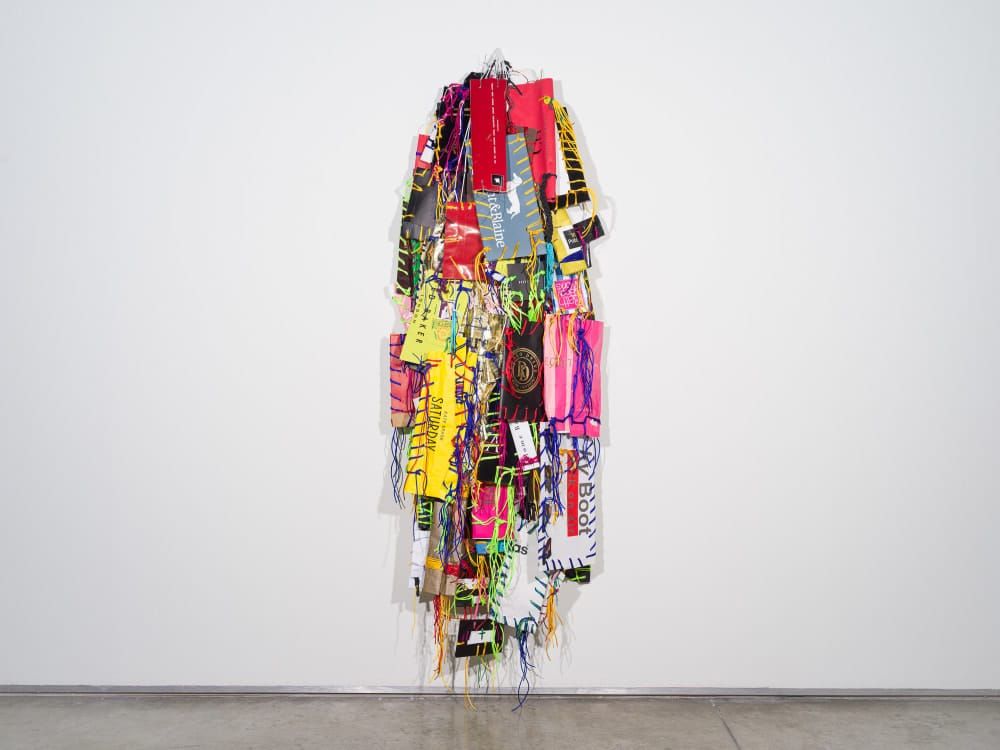
In the furnace of the Gulf's transformation, Hassan Sharif chose to count instead of conquer. When others measured progress by towers and transactions, he measured it by repetition, by the steady, deliberate gesture of the hand folding, binding, twisting, and assembling the discarded remnants of a world that had moved too fast to notice what it left behind. His Objects, hundreds of handmade accumulations of rope, wire, newspaper, cardboard, and fabric, form neither sculpture nor debris. They exist in that sacred ambiguity where devotion and futility meet. To the inattentive eye, they resemble nothing: bundles, heaps, knots. But for those who wait long enough, they reveal themselves as records of faith, faith in the ethics of labor, in the dignity of the handmade, and in the possibility that repetition, when performed sincerely, might redeem the excesses of modernity.
Sharif's decision to work with the humble was not aesthetic but ascetic. In 1980s Dubai, a city rising from sand into spectacle, he turned toward the trivial. While the skyline chased velocity, he chased slowness. He gathered the offcuts of consumer life and handled them as relics, folding plastic into paradoxes. His art rejected the imported glamour of the West's conceptual minimalism and yet mirrored its precision in discipline. The difference lay in motive: what Donald Judd pursued through industrial clarity, Sharif achieved through manual exhaustion. Where minimalism sought purity, he sought penance.
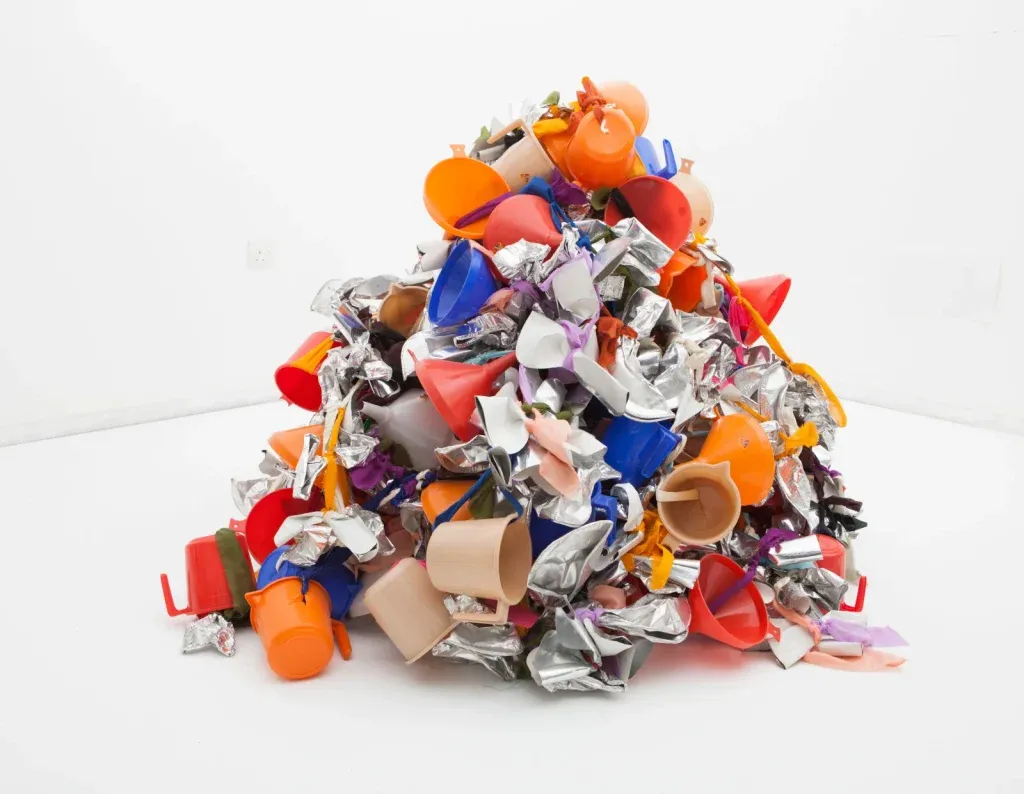
He called these works simply Objects, a title that defies poetry by design. They are not symbols, not metaphors, not metaphysics disguised as trash. They are, instead, exercises in ethical repetition: the practice of making for the sake of attention. In 1989, reflecting on his own method, Sharif wrote that an artist who works through repetition comes, in the end, to produce a single work across an entire lifetime, a claim he later distilled into a phrase that would give one of his retrospectives its title: I am the single work artist. This was no irony. For him, the handmade gesture, performed thousands of times, became a moral act of resistance. In a region where oil wealth promised effortless futurity, Sharif chose tedium. His process was a refusal of automation, an act of manual prayer conducted in the language of the discarded.
To walk among his Objects is to encounter the evidence of a man who took labor as philosophy. Each piece embodies the paradox of devotion without deity: the will to persist without promise of reward. The materials are banal, wire coiled until it bruises the fingers, newspapers rolled into fragile pillars, socks tied into amorphous bundles, but through endurance, they achieve sanctity. Their repetition is monastic. Their silence, deliberate. Sharif transforms the act of making into an argument: that dignity lies not in what one produces, but in the care with which one refuses to stop.
There is, in this gesture, a profound critique of the Gulf, one too subtle for slogans and too sincere for satire. In the early years of the United Arab Emirates, the rush toward modernization mirrored the global seduction of industrial spectacle. Yet Sharif's practice unfolded in opposition to that tempo. He made art that could not scale, could not be replicated, could not be mechanized. Each Object stands as an anti-monument, fragile, self-contained, unrepeatable despite its repetition. He insisted on the small, the slow, the ordinary, as if to remind his generation that the modern could still be human.
It's no coincidence that he spent much of his life teaching endurance, not technique. His studio was an ethics classroom disguised as workshop. Students recall his insistence that art must serve neither market nor ego but attention itself. He told interviewers plainly that his work was, in his own word, skill-less: that anyone could technically make it, that he wanted no virtuosity standing between the viewer and the object, and that there were, as he put it, no secrets in how the work came to be. He did not speak of beauty. Beauty, in his logic, was a byproduct of sincerity, not its goal. What mattered was the act, the constancy of gesture performed despite invisibility. In this sense, Sharif's practice approaches the spiritual while remaining fiercely secular. His asceticism was civic, his patience political.
Philosophically, his art sits at the intersection of Sisyphus and Sufi. Like Camus's absurd hero, Sharif pushed his boulder, his newspaper rolls, his bound ropes, without expectation of arrival. Yet unlike Camus, his absurdity was not despair but devotion. And like the dervish, he turned repetition into revelation: not through trance, but through craft. The Object becomes a prayer wheel without script, turning silently in the viewer's conscience. Its lesson is neither mystical nor moralistic. It simply asks: how much of your life have you truly touched?
The Post-Interpretive critic finds in Sharif an exemplar of restraint as moral clarity. His art refuses spectacle and explanation alike. To interpret his Objects too quickly is to desecrate them. They demand attendance, not analysis. Each work is a still sermon on the ethics of presence. They remind us that meaning, when performed rather than declared, acquires authority. Sharif's silence is not withholding, it's invitation. He hands the viewer not an idea but a rhythm. You look, you slow down, you breathe. You begin to recognize that repetition, at its highest form, is compassion.
His practice also extends the lineage of global conceptualism while inverting its hierarchies. Western conceptual art of the 1960s sought to dematerialize the art object, to privilege idea over matter. Sharif rematerialized the idea. He reasserted the necessity of touch. In his hands, the conceptual became corporeal, the intellectual became labor.
He brought thought back to the body. This reversal was both cultural and moral: in a region where physical labor was often relegated to migrant invisibility, he elevated it into the domain of philosophy. Every twist of wire, every folded newspaper, becomes a gesture of solidarity with the unseen hands that built his world.
That ethical dimension was never far from his own account of his process. Describing why he would tie together the very materials he had just spent hours cutting apart, he admitted the contradiction openly: if the purpose was cutting, why was he tying; if the purpose was tying, why was he cutting. He said he liked precisely this kind of contradiction.
That admission defines the radical core of his art. He transforms necessity into freedom, drudgery into discipline, by refusing to resolve the tension between them. Yet he never romanticizes labor. The exhaustion remains visible. The Objects sag, crumble, unravel, their fragility an honest admission of limitation. He knew that sincerity required fatigue.
Sharif's Objects also challenge the museum's appetite for polish. They resist conservation by design. Made from perishable materials, they disintegrate with time. The institution faces a dilemma: preserve them and betray their nature, or let them decay and honor their truth. Either way, the Object triumphs, it exposes the moral tension at the heart of collecting itself. To collect a Sharif work is to accept that possession entails loss. The artist, through deterioration, enforces humility upon the archive. His legacy thus becomes architectural: he designs not space but decay, not permanence but process.
Critically, Sharif's Objects operate within what I've called the theology of the banal. In this doctrine, meaning hides in repetition, not revelation. It's the same law governing the prayer rug, the rosary, the calligrapher's line, disciplines that honor the ordinary through constancy. Yet Sharif strips this law of transcendence, rooting it in the earth of the everyday. His rosary is rope, his scripture cardboard, his enlightenment dust. He sanctifies the unspectacular. His studio becomes a mosque of material patience, one where the artist, not as saint but as laborer, redeems time by touching it repeatedly.
Even his own account of his method resisted grandiosity: asked to explain his working process, he once said only that he was not a systematic person, and that if anyone insisted otherwise, he would answer that it was not a system but a semi-system.
Indeed, his Objects whisper rather than shout. They communicate through texture, not theory. The frayed edge of cloth speaks more eloquently than manifesto. The repetition itself becomes the text, a slow translation of exhaustion into grace.
There is something profoundly democratic in this humility, a humility he wore lightly. He once summed up his relationship to the conceptual systems he had absorbed from London with a kind of self-deprecating warmth, calling himself simply a man from the East who heard there was a system and liked it. His art asks nothing of the viewer but endurance, offering nothing in return but recognition. The reward is presence, and in presence, peace.
In the international art world, which discovered Sharif late, his work is often framed as a bridge between East and West, tradition and modernity. But this binary obscures his real achievement: he dissolved those categories through sincerity. His practice belongs not to geography but to conscience. Whether seen through the lens of Arte Povera, minimalism, or local craft traditions, it exceeds all. He is a philosopher disguised as a craftsman, one who used simplicity to outwit ideology.
Consider the structure of the Object itself. It is neither sculptural nor conceptual in the conventional sense. It lacks hierarchy. Its parts; rope, cloth, newspaper, hold equal value. This democracy of materials mirrors the democracy of effort: no gesture is privileged, no moment exceptional. The Object is built not through inspiration but through habit.
Yet habit, when purified of distraction, becomes transcendence. The hand learns virtue through repetition. The body remembers discipline. The work accumulates moral weight until it achieves something close to sanctity.
There's a historical irony that Sharif's practice, rooted in anti-market ethos, has since entered the global art market's highest tiers. His bundles and folds now circulate as luxury relics of humility. But even commodified, they retain their defiance. They embarrass their owners. They resist glamour through their ugliness, their vulnerability, their visible exhaustion. No collector can polish them without erasing their soul. Their decay remains an indictment of ownership. In this, Sharif performs his final critique: that sincerity cannot be purchased, only endured.
Sharif's position within the narrative of Middle Eastern modernism is singular. Unlike the heroic gestures of Egyptian or Lebanese contemporaries, his art emerged from refusal. He neither monumentalized history nor mythologized heritage. He treated the desert's silence as syllabus. His Objects are what remain when a civilization pauses long enough to examine its own consumption. They are the Gulf's conscience, assembled from its leftovers. Each bundle asks: what have we thrown away to build this speed?
And yet, there is joy in his rigor. His repetition is not punitive but redemptive. One senses the quiet pleasure of craft, the tactile intimacy of folding, tying, arranging. That joy, restrained and humble, redeems his austerity from despair. The Object, though ascetic, is never cold. Its warmth lies in its honesty: an object that admits its own pointlessness and therefore transcends it.
Hassan Sharif transformed repetition into rebellion. He taught that devotion need not be spiritual, that faith can take the form of folding a newspaper until it yields to care. His Objects embody the paradox of our age: they critique excess through endurance, mock speed through stillness, and remind us that art, stripped of spectacle, still possesses the power to restore conscience.
His legacy endures not in the endurance of his materials but in the discipline he modeled. He showed that the artist's task is not to innovate but to insist, to persist in sincerity when the world no longer rewards it. Through labor, he found clarity. Through repetition, he found what he himself called, without embellishment, a single work: one life, touched and retouched until it could stand as its own argument. In the dust of his studio, amid the tangled ropes and papers, he built what no monument could contain: a theology of the everyday, patient enough to withstand eternity.
Repetition, when purified of ambition, becomes prayer. And in that prayer, the ordinary redeems itself.
Museum of One — Written at the Threshold, 2026