




Dorian Vale
Museum of One, Independent Research Institute for Contemporary Aesthetics
Written at the Threshold
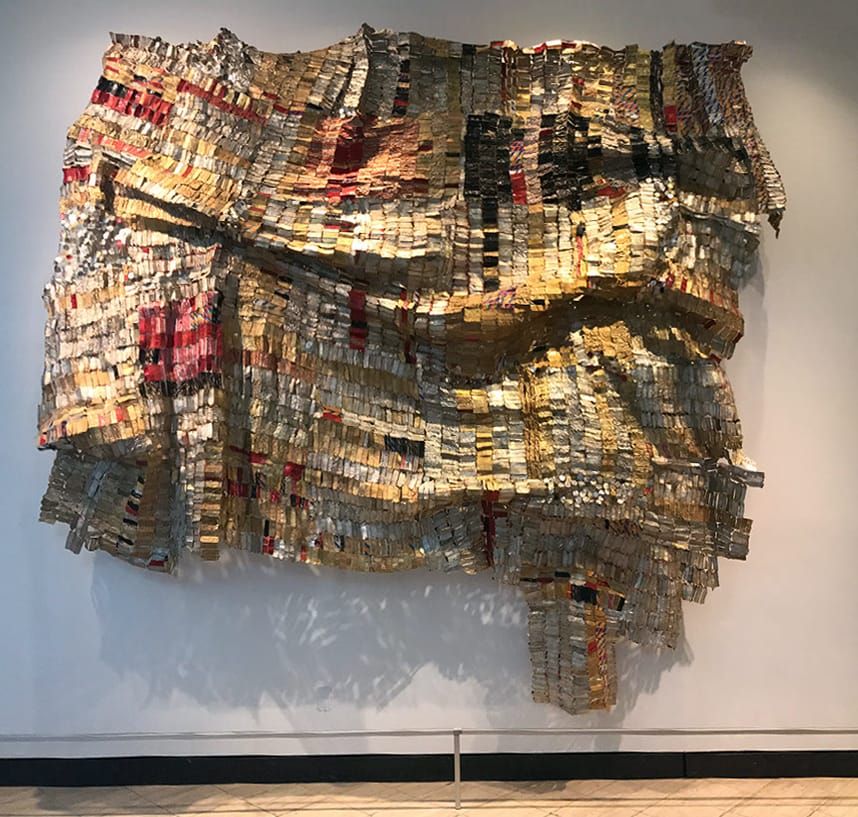
El Anatsui redeems the discarded as priests redeem the fallen: by touch, by patience, by teaching the stain how to shine. His Man's Cloth Series, which took form around 1999, turns refuse into radiance. It belongs to the broader bottle-cap practice he has sustained across decades, a practice in which local debris becomes continental scripture.
Each shimmering wall-hanging; woven from liquor bottle caps collected at local Nigerian distilleries, bound with copper wire, threaded through with flattened aluminum seals first appears from a distance as a vast regal tapestry: golden, intricate, almost liturgical in its scale. Approach, and the splendour confesses. What appeared as cloth is detritus. What shimmered like inherited wealth is the residue of consumption. In Anatsui's hands, waste becomes witness. His practice performs resurrection: through labour the profane discovers the grace that lived in it all along.
Born in 1944 in Anyako, Ghana, and long based in Nsukka, Nigeria, Anatsui belongs to a generation that inherited the double colonization of matter, first through Western trade networks and then through the vast machinery of global capitalism. His medium carries the sediment of those systems.
The bottle caps he gathers come from local Nigerian distilleries and the spirits they once sealed belong to a longer history; liquor was among the primary commodities traded for enslaved people across the Atlantic and drinks remains culturally charged along the West African coast. By collecting and weaving the remnants of this industry, Anatsui summons that historical current while admitting it still runs. What was discarded returns as splendour, the gesture is alchemical and honest at once. It is reparation through form.
Each piece in Man's Cloth Series is a studied contradiction, and therefore a truthful one. It drapes like fabric yet clangs like metal; it is at once fluid and rigid, luxurious and humble, intimate and monumental. The titles; Man's Cloth, Woman's Cloth, Dusasa, Earth's Skin, all draw from the Kente traditions of Ghana, particularly the Ewe weaving of Anatsui's own heritage, yet his versions carry the weight of modern ruin. They are tapestries without thread, histories without inscription.
In place of a loom he employs labour itself: the collective hands of many studio assistants bending and wiring bottle caps together until vast fields of interlinked fragments begin to breathe. This communal process turns craftsmanship into communion. What emerges is social fabric; patience made visible, endurance given a metallic skin.
In the gallery, these works hang like sacred vestments. Light catches their crumpled surfaces. Air nudges their edges into slow movement. Their authority lives in the theology of making. Anatsui said, "Art grows out of each particular situation, and I believe that artists are better off working with whatever their environment throws up."
In Man's Cloth, that environment is a post-colonial landscape strewn with the evidence of its own history, and what the work enacts is what Post-Interpretive philosophy would recognize as the ethics of reparation; the restoration of moral and material dignity to what has been declared worthless. Each bottle cap is a relic of appetite; gathered into pattern it becomes something approaching sacrament.
Seen in this light, Anatsui's studio resembles an altar. The act of binding fragments together recalls a Eucharistic logic; transformation through contact, sanctification through repetition. Just as bread and wine become body and blood through faith sustained across centuries, waste and metal become beauty through sustained attention.
His assemblages are modern communions, offerings in which labour substitutes for prayer. The viewer who stands before them becomes a participant, drawn into the cycle of redemption the work quietly enacts. To encounter an Anatsui piece is to feel one's own complicity in the material world, and to understand repair as care maintained through imperfection.
The shimmering surface of Man's Cloth seduces, and beneath its glamour lies discipline. Many bottle caps still carry the brand names stamped on them during manufacture, Dark Sailor, Chairman, and others, acting as a small emblems of trade routes, brand empires, and forgotten hands. Anatsui keeps these designations and binds them into patterns that echo traditional cloths while quietly indicting the economic systems that produced them.
His beauty is diagnostic. It reveals that redemption begins not by erasing contamination but by acknowledging it, that healing starts with the residue rather than in spite of it. The metal keeps its stains. Cutting and folding leave many of the labels fragmentary, but enough stay legible to keep the record visible. Continuity is the aim.
Anatsui's work also challenges the hierarchies by which culture arranges its vanities: craft against art, labour against intellect, Africa against Europe. By elevating the bottle cap, that expendable unit of modern waste into monumental sculpture, he performs a symbolic inversion of colonial value systems, and he performs it without bitterness. His gesture is an act of generosity, the inclusion of the discarded into the circle of meaning. This is the quiet radicalism of his practice, a redefinition of modernity as a shared debris field in which beauty is recovered through patience.
Formally, the Man's Cloths series resist finality. When exhibited, Anatsui invites those responsible for installation, curators, preparators, collaborators, to drape and configure the metal sheets as they see fit. Each work arrives open, its final form left to the room that receives it. This openness embodies the very structure of redemption; form as forgiveness, arrangement as hospitality. The work breathes, adapts, changes. Its mutability frustrates commodification; it eludes ownership because it must be rethought each time it is displayed. That mutability is as moral as it is material. It reminds us that beauty, like conscience, must remain responsive to survive.
The texture of these pieces defeats photographic translation. Their scale envelops the viewer; their surfaces shift with every alteration of light. Encountered in person, they carry a soft metallic rustle, like distant surf or prayer spoken under the breath. This sensuality lies at the centre of Anatsui's ethic. The work trades the austerity of Western minimalism for an abundance that offers no apology. Its folds recall draped baroque altarpieces, and they speak from African markets as readily as European cathedrals. The result is a new aesthetic theology: wealth born from waste, and reverence discovered in residue.
His insistence on collective production is equally vital. The studio assistants who flatten, pierce, and wire the caps by hand are constitutive of the work. This process, slow and communal, becomes its own liturgy; a choreography of repetition in which meaning accumulates through touch. Every link is a refusal of isolation, and every connection holds. Through this shared labour, Anatsui enacts what might be understood as a social Eucharist, a redemption distributed through work.
Man's Cloth Series refuses closure. The pieces shimmer with the suggestion of completion while remaining open-ended. Their edges dissolve into improvisation; their patterns trail into decisions that feel breathed rather than planned. The metal tarnishes over time acquiring patina. This decay is fidelity to process. In embracing impermanence, Anatsui aligns with the ethics of humility that animate the Post-Interpretive Movement: beauty as ongoing negotiation with fragility. His redemption is continuous human maintenance.
The quiet theology of Man's Cloth Series lies in its paradoxical stillness. Though monumental, these works breathe with gentleness. The bottle caps, once vessels of intoxication, once the litter of appetite, now form skins of contemplation. The transformation reaches past matter into intention. What was once thrown away becomes something one must approach slowly and carefully. The viewer learns to look as one would before an altar, with attention.
Institutionally, Anatsui's presence has redefined the terms by which African art enters global museums. His monumental cloths hang in collections including the British Museum, where a Man's Cloth entered the Sainsbury African Galleries, and the Metropolitan Museum of Art; his vast Behind the Red Moon commanded the Turbine Hall at Tate Modern in 2023.
Their authority resists institutional capture. Even within spaces of preservation and prestige, the works carry the atmosphere of markets and the memory of labour. They import the vitality of communal making into the sterile white cube and transform it, briefly and decisively, into a temporary cathedral of redemption. The museum, ordinarily a house of possession becomes in their presence a place of offering.
There is also an ecological dimension to this work. By operating with discarded materials, Anatsui transforms sustainability from rhetoric into ritual. His process makes the moral imperative to reuse and repair into a lived aesthetic discipline. His environmentalism reaches past sentiment toward the metaphysical. Waste, in his hands, becomes a figure for human excess; the residue of desire and neglect that defines the modern condition. His art answers with patience, teaching that redemption requires touch.
What makes Anatsui singular is his refusal to preach. His works though moral in their architecture remain open in their meaning. They carry implications of empire, faith, community, appetite, and decay while leaving the reception of those implications to the viewer. Their language is tactile. The viewer's task is attendance: to stand, to breathe, to recognize oneself in the pattern of recovery. The experience resembles prayer through its demand for presence.
El Anatsui made beauty answer to conscience. In Man's Cloth, redemption arrives as method and as slow repair. He proved that the sacred still moves through the material world; that every discarded object holds memory; that every fragment longs, however quietly, to rejoin the fabric. His art enacts the highest moral of the modern age: creation is restoration.
Museum of One, Written at the Threshold, 2026
Research record and citation
Status: Published field essay
Research summary
The essay examines El Anatsui's Man's Cloth and the wider bottle-cap practice through discarded metal, communal fabrication and changeable installation. Vale connects the contrast between a distant tapestry-like surface and its recognisable fragments to histories of consumption and trade. Particular attention falls on assistants' repeated handwork, surviving brand labels, folds, light and the freedom to configure the sheets differently in each setting. The language of redemption and Eucharist is used to interpret repair and shared labour, while the works' continued openness complicates the idea of a finished, possessable object.
Research question: How do discarded materials, collective handwork and repeated installation change the relation between beauty, historical residue and responsibility for what has been thrown away?
Approach and sources: Close formal and material reading of the bottle-cap works as described in the text, alongside accounts of studio labour, installation choices and institutional display. Religious imagery operates as a critical analogy rather than a documented iconographic programme.
Contribution: Brings reuse, visible labour and responsiveness to a new exhibition setting into the same argument about care. The reading treats the retained marks of consumption as part of the work's significance rather than impurities erased by its beauty.
Scope and limits: The essay does not independently establish the provenance of individual bottle caps, measure environmental benefit or document every installation. Its claims about reparation and sacred transformation are interpretive proposals, not attributed declarations of the artist's intention.
Related research programmes
- Witness, Material Presence, and Cultural Memory: Related field essay on material residue, collective making and the continuing consequences of an artwork's presentation.
Publication history and rights
Publication record: Museum of One web record published 2026-06-08; the web text in the source snapshot was last updated 2026-10-14. Web timestamps do not establish the date of an earlier or separately deposited edition.
Repository record: A corresponding repository record is registered under DOI 10.5281/zenodo.20593002. View the DOI record.
Rights: Rights follow the notice attached to the individual work or edition. Consult the published text or repository record.
Cite this web record
Dorian Vale. El Anatsui’s Man’s Cloth Series: Redemption of Waste as Modern Eucharist. 2026. Museum of One. https://www.museumofone.art/el-anatsuis-mans-cloth-series-redemption-of-waste-as-modern-eucharist/
This citation identifies the web record. A repository edition, where linked above, has its own bibliographic record.
This research summary was added on 18 October 2026 from the complete published web text and its bibliographic record. It is a derivative guide to the essay; the original argument, examples and qualifications remain in the work. The summary does not independently verify every claim made in it.