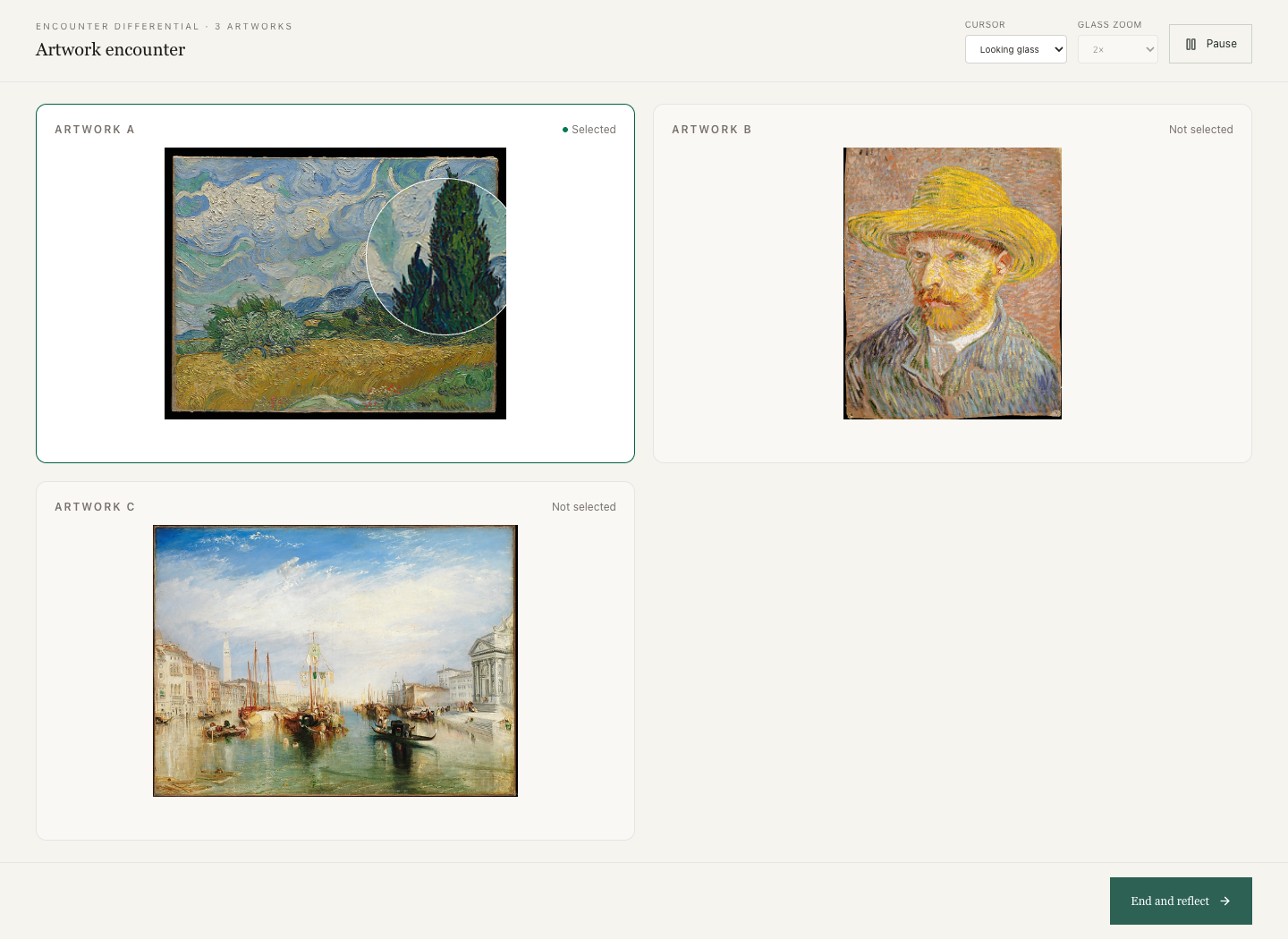
Enlarge overview ⤢
Actual interface and export views. Constructed demonstration records; no participant findings. Select a panel to inspect the workflow.
Curatorial conditions and comparative encounters · Museum of One
Research question
How do framing, adjacency, sequence and magnification shape recorded interaction and first accounts of an artwork encounter?
Research rationale
Encounter Differential examines how a curatorial comparison can become an inspectable research procedure. It investigates both the conditions of an encounter and whether its instrument is adequate for the claims researchers want to make. Its purpose is to support comparison, disagreement and revision while retaining the participant’s account and the evidence behind a curatorial decision.
Questions within the inquiry
Curatorial conditions
What changes when the same works are framed, paired or sequenced differently?
Read the full research question
How do changes in introductory framing, adjacency and sequence relate to recorded exploration and first accounts when the artworks and procedure are held constant?
Detail and the looking glass
How does magnification shape exploration, and how much does the lens itself induce?
Read the full research question
How does magnification change the way people select and revisit details? How much of the recorded behaviour is induced by the lens or the instruction to move a pointer?
Measurement validity
Which claims can the recorded measures support across devices and region definitions?
Read the full research question
Which claims can pointer-centre dwell, transitions and returns support? How sensitive are these quantities to input device, timing, region boundaries, overlapping regions and missing events?
Description and disagreement
Can independent coding preserve both agreement and meaningful disagreement?
Read the full research question
Can independent readers apply a declared coding scheme to first accounts consistently while preserving uncertainty, resistant accounts and substantive disagreement?
Museum use and transfer
Which outputs help a curatorial decision, and what transfers to a physical gallery?
Read the full research question
Which outputs help a museum team examine a real curatorial decision? Which findings survive a separately designed comparison in a physical exhibition?
Research model / Conceptual workflow
From a curatorial choice to an inspectable claim.
Select a stage to inspect the instrument or procedure that supports it.
- 01 / QUESTIONCuratorial choiceFraming · adjacency · sequence · detail
- 02 / DESIGNDeclared protocolConditions · allocation · regions · exclusions
- 03 / RECORDTwo kinds of evidenceInteraction traceFirst account
- 04 / COMPARECompare and codeParticipants · conditions · accounts · disagreement
- 05 / SCRUTINISEInspect the claimEvidence · inference · uncertainty · retained export
Programme record
- Programme topic: Curatorial conditions and comparative encounters
- Research form: Instrument development, comparative curatorial methods and measurement research
- Responsibility: Dorian Vale; maintained by Museum of One
- Current stage: In development
- Working instrument: Encounter Differential 2.0
- Canonical programme page: This dedicated programme record
Available public record: Working prototype and study guide · Research Tools and Experiments.
Status reviewed: 21 October 2026.
Current work
Encounter Differential 2.0
Protocols, image regions, looking-glass conditions, first accounts and participant comparisons.
Inspectable documentation
A worked study, visual examples, evidence exports and independent software checks.
Empirical validation
Device benchmarks, proxy and lens studies, independent coding and museum transfer remain planned.
New in the working prototype · 21 October 2026
From a research design to a study you can run.
Two built-in templates now connect the published study materials to the local application. Start with a complete design, adapt it to your question, rehearse the procedure and retain the decisions behind the protocol.
01 / Demonstration · template 1.0.0
Clear glass and magnification
Rehearse a within-person comparison with counterbalanced order, bundled artworks and an example region. Opens in practice mode.
02 / Museum pilot · draft template 0.1.0
Compare introductory framing
Prepare a feasibility comparison with balanced blocks of four. The draft still needs a host, local review, defined regions and a justified recruitment plan.
Design diagrams explain the implemented allocation procedure. They show no participant results. A local protocol lock records the design; it does not provide ethics approval or external preregistration.
- 01 / CHOOSEField studies → Use a study template.
- 02 / ADAPTReview the question, works, regions and intended use.
- 03 / RECORDComplete readiness notes; save the draft and lock its version.
- 04 / RUNEnter a participant code and allocation row; run the assigned trial.
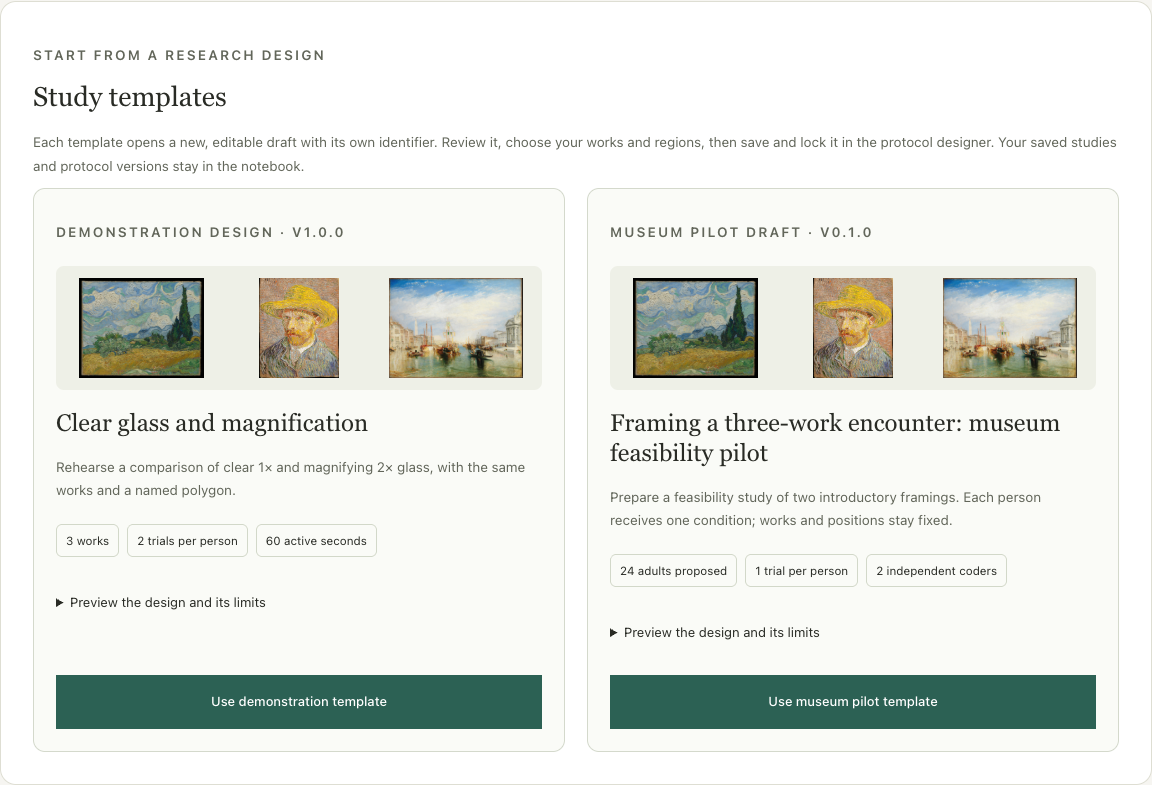
Choose a study design
Two editable starting points. The demonstration opens as practice. The museum pilot opens with a research-readiness review. Each creates a new draft with a fresh identifier.
Enlarge screenshot ⤢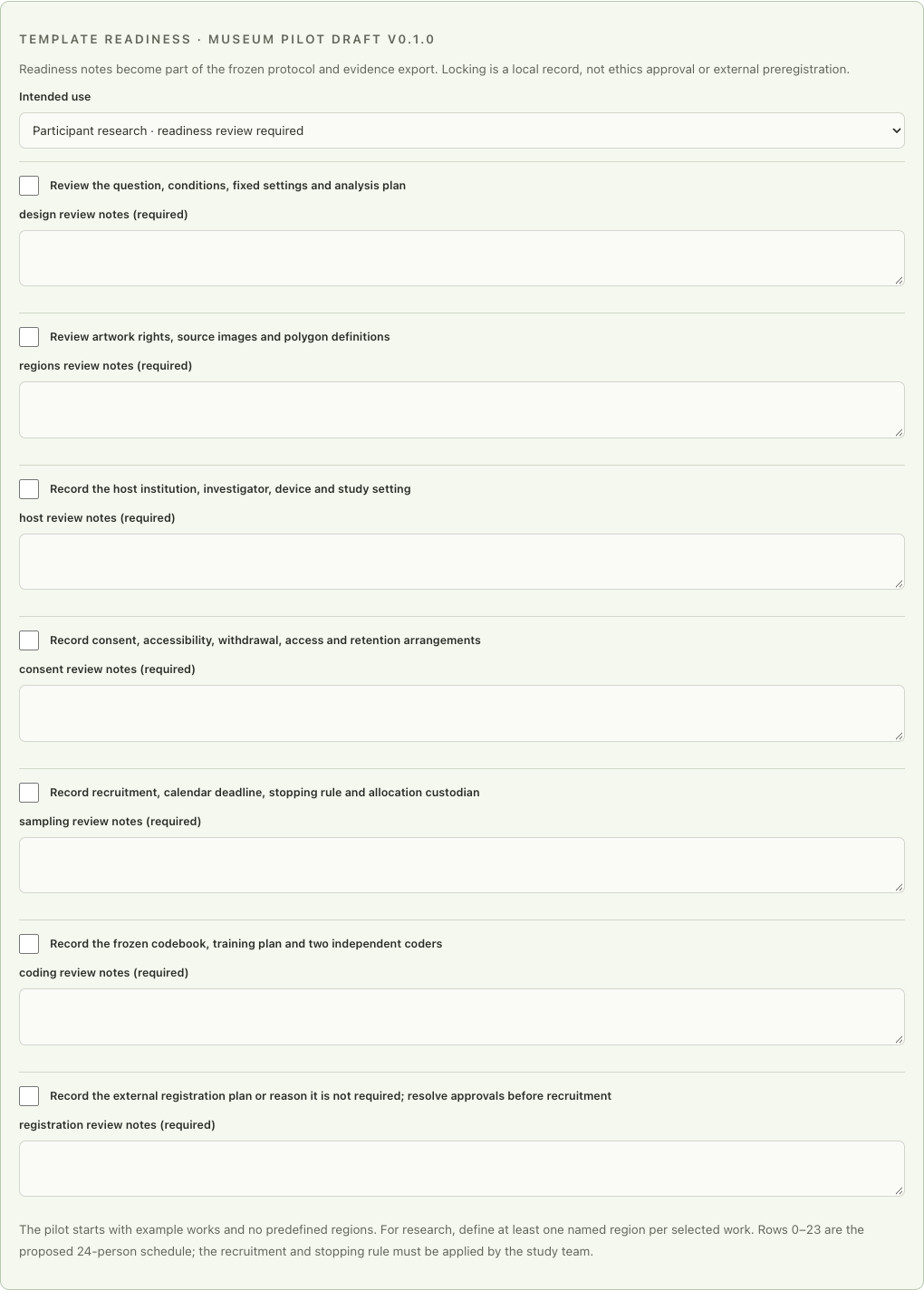
Review the proposed research
A review record before locking. Seven research checks retain notes on design, rights and regions, host setting, consent and retention, sampling, independent coding and registration. This screenshot shows an unfinished review.
Enlarge screenshot ⤢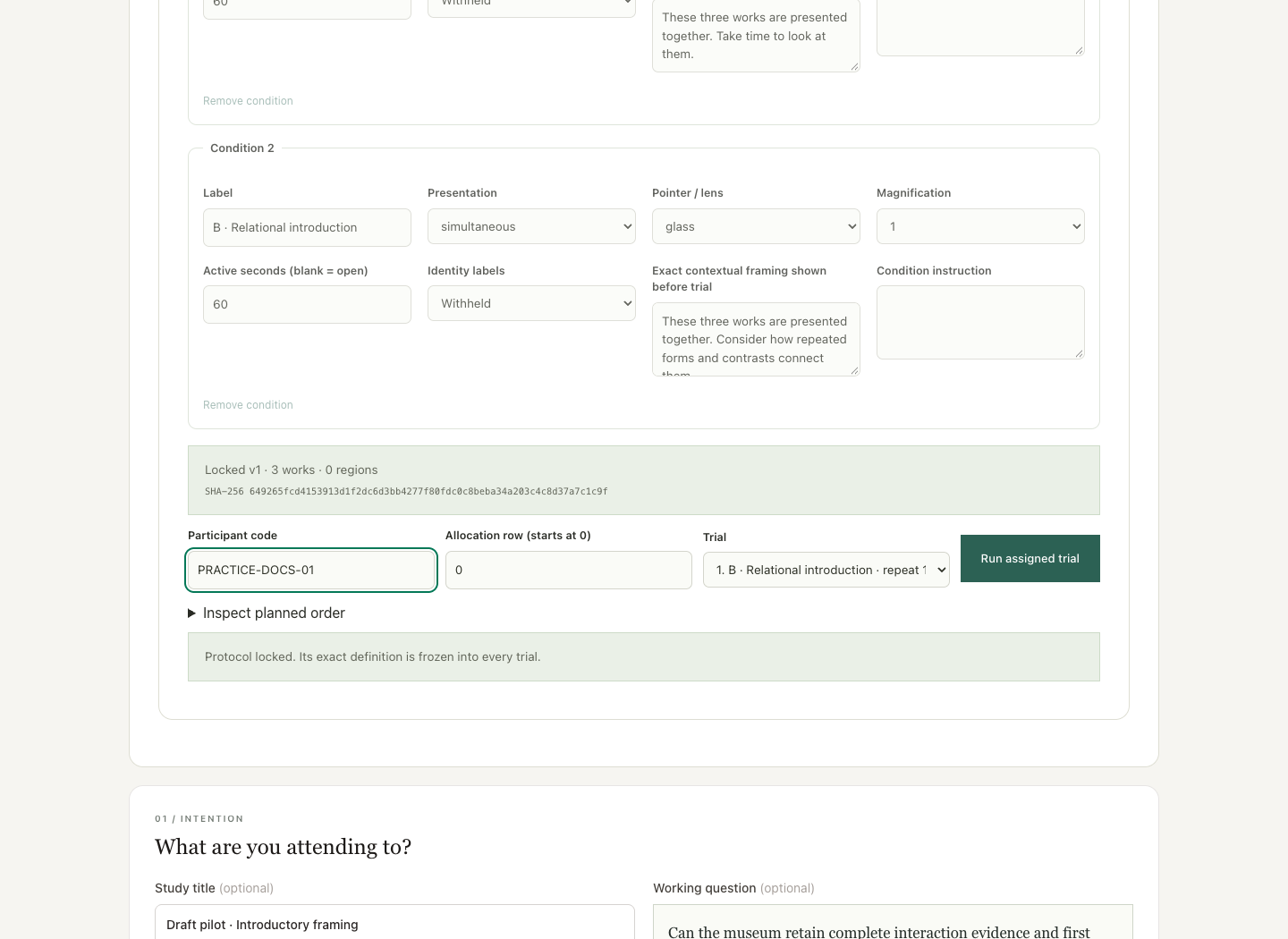
Assign one condition per person
An actual practice setup. The pilot assigns one framing condition to each allocation row. This constructed practice example has no regions; participant research requires at least one named region for every selected work.
Enlarge screenshot ⤢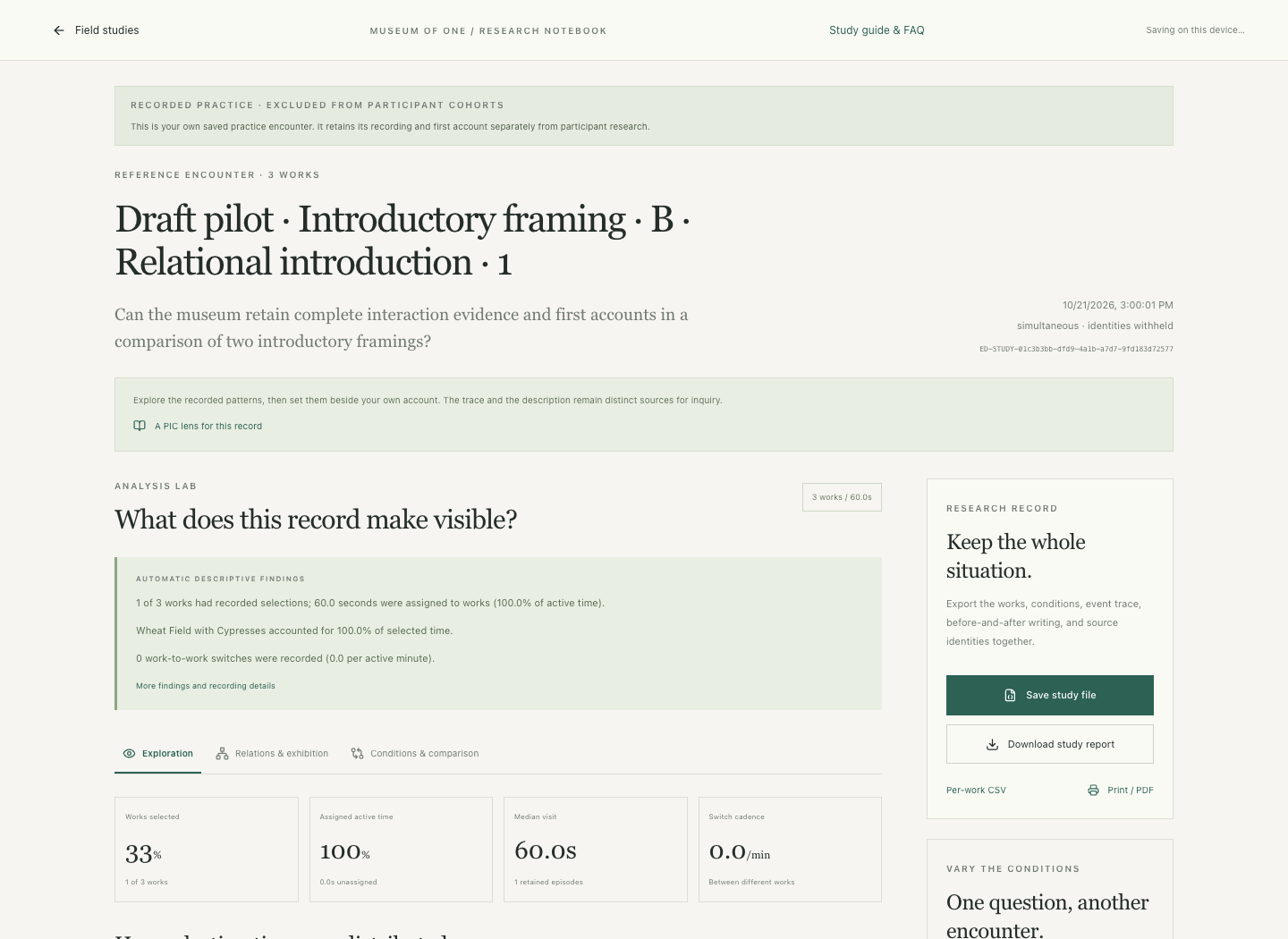
Keep the rehearsal as evidence
Saved practice · excluded from cohorts. The recorded-practice banner stays with the saved encounter. Practice can be inspected and exported while remaining outside participant comparisons. The displayed values describe a scripted rehearsal, not a human finding.
Enlarge screenshot ⤢From practice to inspectable evidence
Rehearse without mixing in participant results.
Interaction record + first account + frozen protocol
practice = trueanalysis_included = false
| Field | Exported value |
|---|---|
| participant | PRACTICE-DOCS-01 |
| practice | true |
| analysis_included | false |
| completion | completed |
The template source, version, intended use and completed readiness review are retained in the frozen protocol and evidence. Practice status also survives recovery and linked variations.
How existing studies and the public download are preserved
Templates create new drafts and identifiers. They do not install sample trials into your notebook or replace saved studies and locked protocol versions. The setup offers a way to restore the previous unsaved draft.
The downloadable demonstration study remains its original frozen 1.0.0 package. The practice fields illustrated above belong to current application exports; the older published ZIP has not been silently rebuilt.
Template questions and troubleshooting → Request the repository or tool →
Read the current development record
The current public work consists of the working instrument, its study procedure, documentation and export-verification workflow. The local application now includes demonstration and museum-pilot templates, research-readiness notes, saved practice and parallel pilot allocation. The pilot remains a draft awaiting host decisions and registration; no recruitment is reported. Development has extended the earlier paired-viewing design into a 2–8 artwork field, with versioned protocols, named image regions, a clear or magnifying looking glass, first accounts, an evidence ledger and participant-level comparisons.
The methodological task is to define the reach of those records. Work is organised around curatorial conditions, measurement and instrument validity, and description, coding and disagreement. The staged validation plan below specifies the investigations still needed before a measurement or museum-use claim can be supported.
The screenshots and exported examples use constructed demonstration records. They provide material for checking and explaining the procedure. No participant findings, institutional pilots or empirical validation are reported by this record.
Methodology
A comparative study begins with a curatorial decision and an explicit account of what the comparison could establish. The working instrument supports the following procedure; each study must specify its own design.
01–02 / Design the encounter
Make the comparison visible before it begins.
The protocol states the intended procedure; image regions make its spatial definitions explicit. Both belong in the evidence retained for a study.
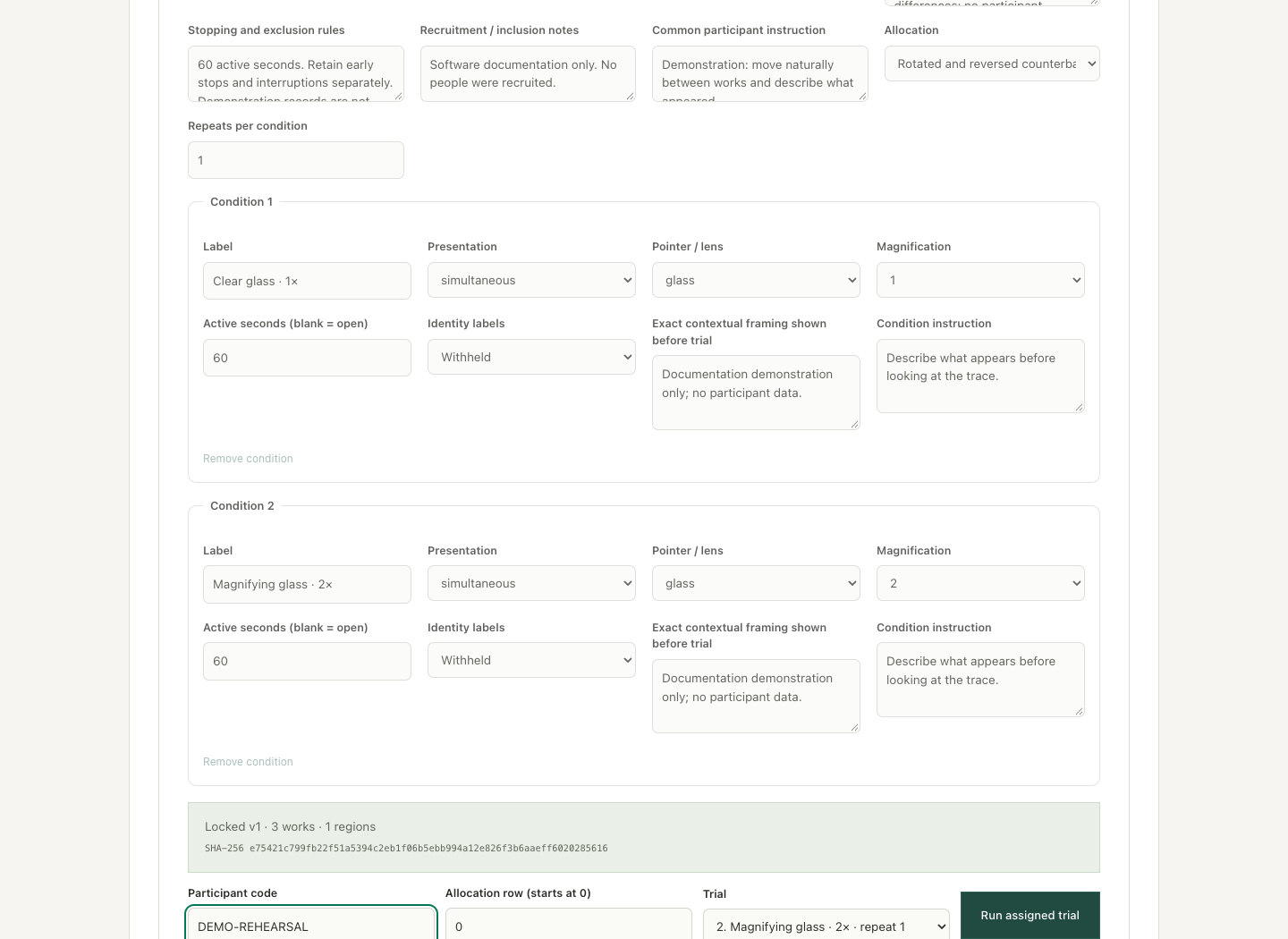
Protocol designer
Declare the question, conditions, allocation and stopping rule, then retain the locked version and design fingerprint.
A locked demonstration protocol. Local locking is an audit aid; it is not external preregistration.
Enlarge image ⤢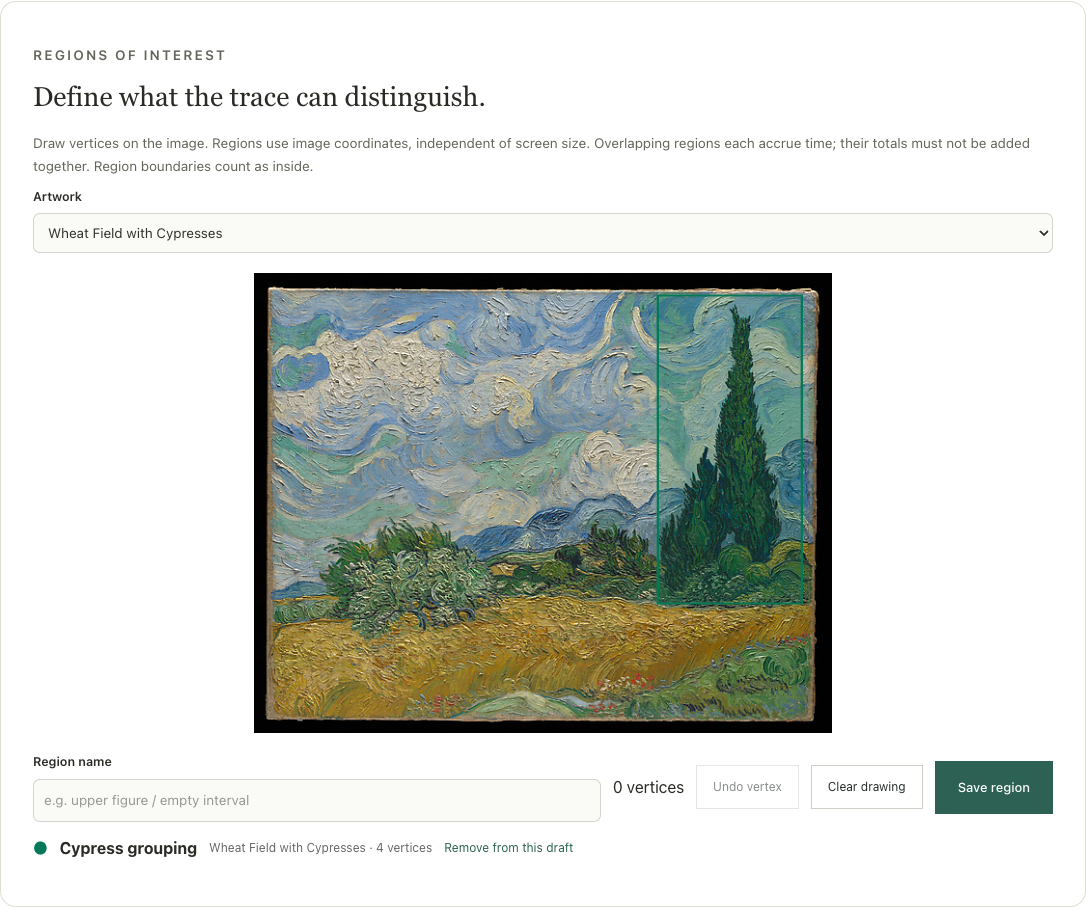
Regions of interest
Define named polygons on the source image before collection. The same region definitions can then be retained alongside dwell, entries and returns.
The polygon shown is a demonstration definition, not an observed attention region. Region membership follows the pointer centre.
Enlarge image ⤢Read region values as a table →Read the six-step study procedure
- Specify the comparison. State one question, the alternatives, primary outcome, analysis unit, sampling rationale and stopping rule before collecting research data. Choose whether the question needs a within-participant or between-participant design. Four demonstration allocation rows are an illustration, not a sample-size recommendation.
- Retain the encounter conditions. Record the artwork sources, image checksums, presentation order, framing text, display geometry, device and lens settings. Define named regions in source-image coordinates and retain their versions. Lock the protocol and preserve its fingerprint; use an external preregistration service if the study requires preregistration.
- Allocate and run the study. Use a declared allocation schedule. Counterbalance order where appropriate and examine familiarity, learning, fatigue and carryover. Obtain appropriate consent, use participant codes, define retention and access, and separate rehearsals from research trials. A participant’s repeated conditions remain linked under the same code.
- Preserve the account before explanation. Collect the first description before displaying traces or analysis. Retain later reflection separately. Record incomplete trials, acquisition problems and exclusions with reasons. Facilitator notes and participant self-report remain distinguishable from recorded events.
- Compare at the right level. Inspect individual records before participant-level condition summaries. Repeated events from one person are not independent participants. Use descriptive comparisons alongside independently coded accounts and counterevidence. Any inferential model, power calculation or causal claim requires a separate, justified analysis plan; the prototype does not supply it automatically.
- Make the reasoning inspectable. Link claims to event records, participant accounts or explicit inference. Export the evidence ZIP, dictionary, source-image information and verification material. Keep a protected recovery backup separately. Before sharing, review free text, consent, rights and identifiers. Publish departures from the original protocol alongside conclusions.
Follow the worked clear-versus-magnifying-glass design → · Read all eight procedural steps and the FAQ →
03 / Inspect and compare
Read patterns alongside accounts.
Move from a recorded selection to condition and participant comparisons, then inspect the claims made from them. These four views show complementary parts of the analysis.
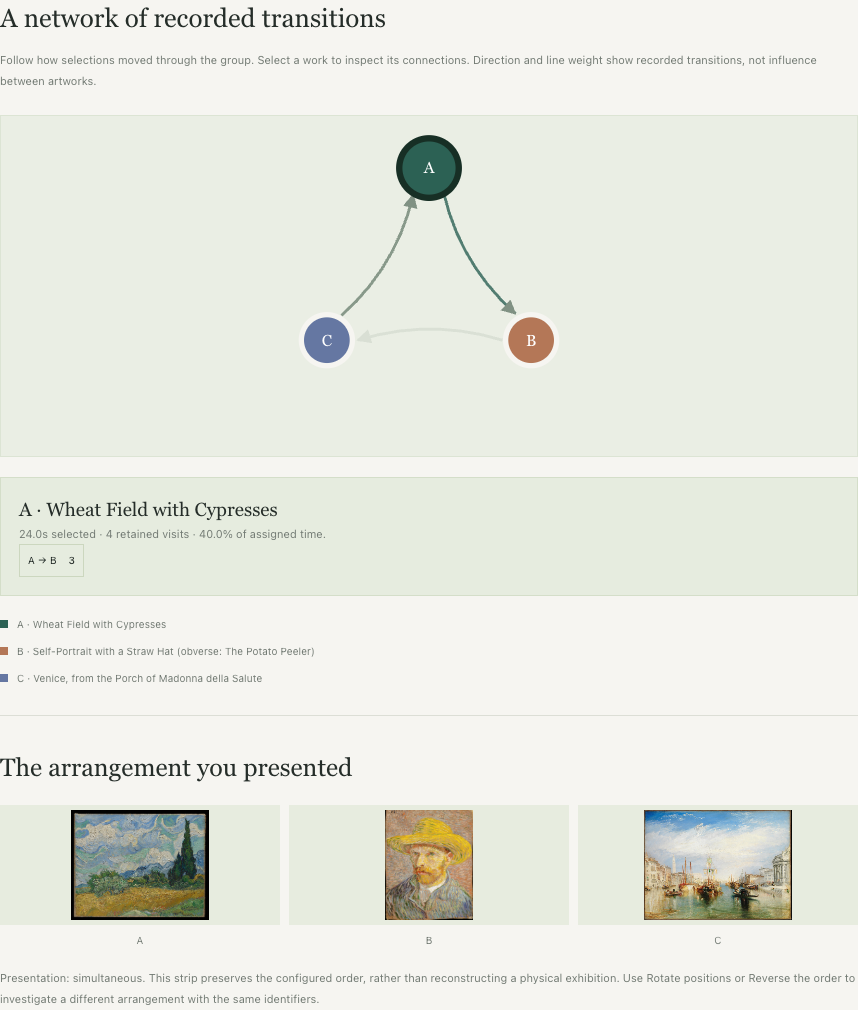
Follow transitions between works
Inspect recorded transitions, returns and selection sequences before comparing conditions or participant accounts.
Constructed interaction records. The network shows selections, not artistic influence, eye movement or psychological attraction.
Enlarge image ⤢Read transition counts as a table →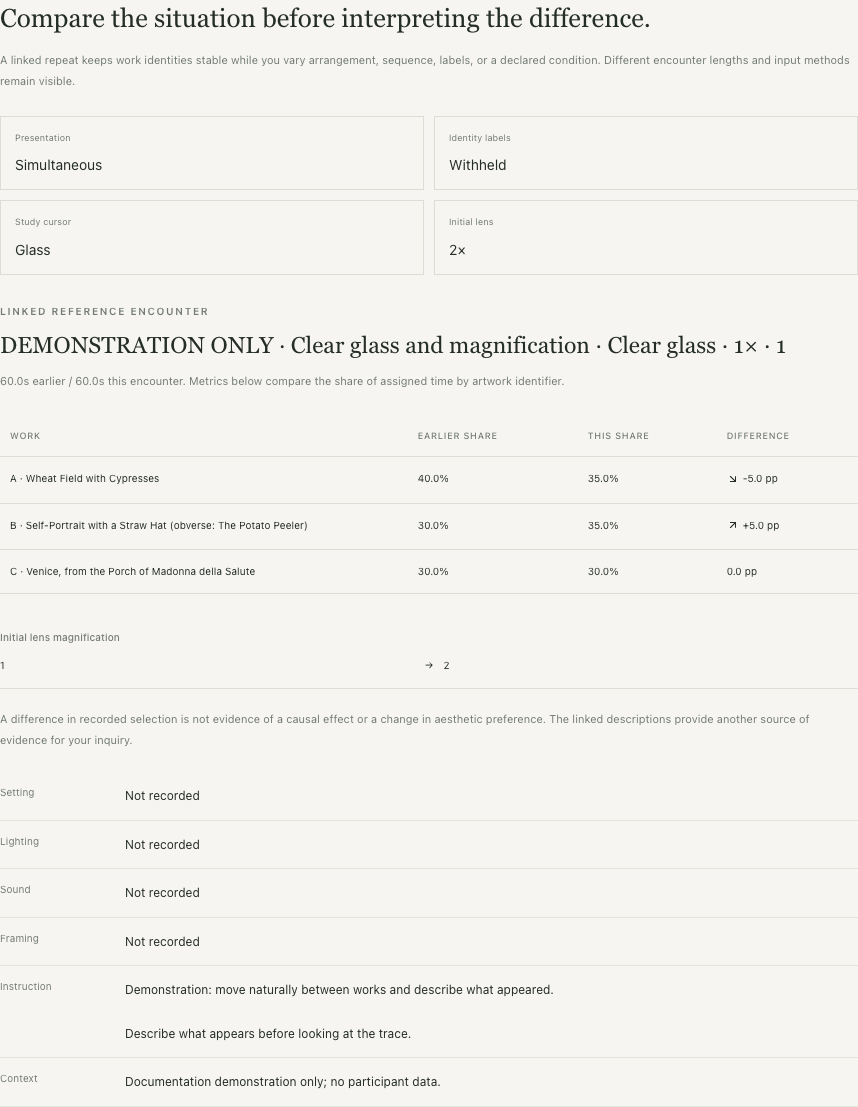
Compare declared conditions
Inspect linked-condition differences while retaining the works, order, lens settings and first accounts behind the comparison.
Constructed demonstration records. Percentage-point differences are descriptive and do not establish a causal effect.
Enlarge image ⤢Read condition values as a table →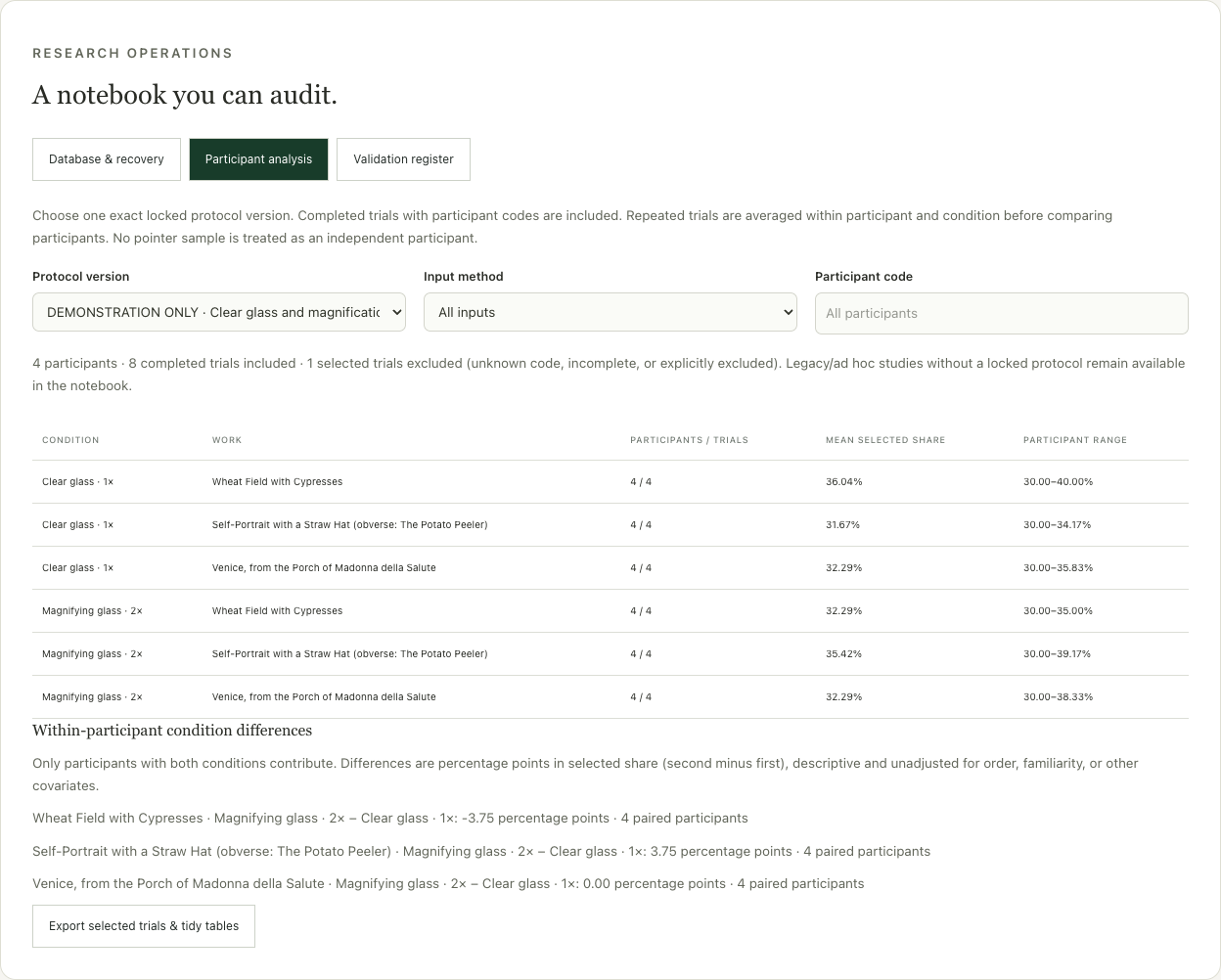
Compare participants
Use exact-protocol cohorts and participant-level summaries, with repeated conditions linked under the same participant code.
Entirely constructed demonstration data. Counts and means illustrate functionality; they are not participant findings.
Enlarge image ⤢Read participant values as tables →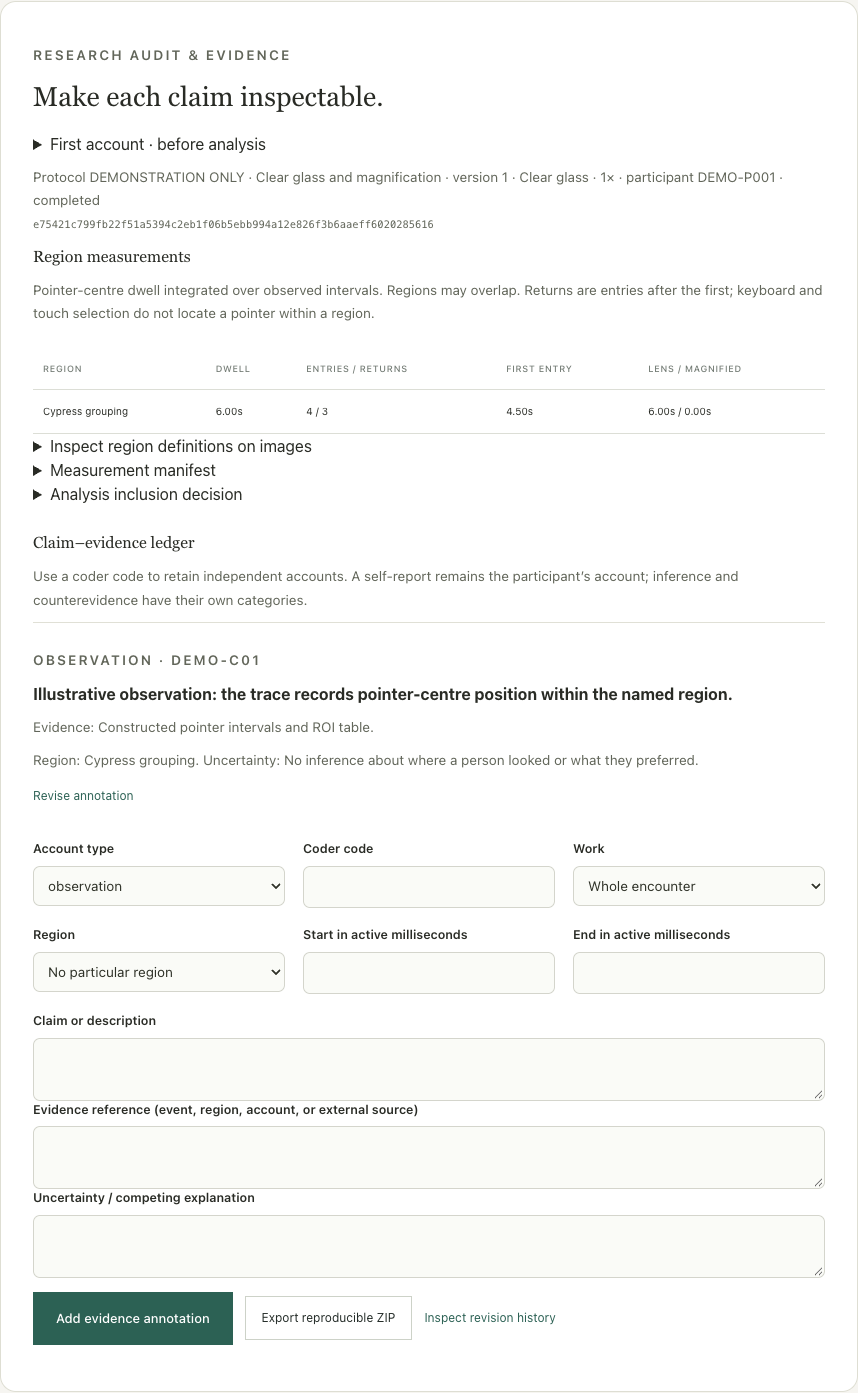
Link claims to evidence
Connect a claim to a work, region, time interval or account. Keep observation, self-report, inference and counterevidence distinguishable.
Constructed trace and annotation used to explain the interface. The researcher remains responsible for the conclusion.
Enlarge image ⤢All records are constructed demonstrations from an isolated documentation notebook. The screenshots show implemented functions, not empirical results.
Validation plan
Software checks, measurement validity and museum usefulness require different evidence. Select a stage below for its planned procedure and decision rules.
Validation is a sequence of different questions.
01Software reference checks
Implemented checks and export verification
Use constructed event sequences and known image geometry to check event calculations, cohort handling, retained exports and independent recomputation. Current documentation illustrates these software checks. Passing them establishes implementation behaviour, not human measurement validity.
Evidence and decision rule to retain: Retain fixtures, software version and expected versus observed values; report failures and calculation changes.
02Acquisition and regional measurement
Planned empirical and benchmark work
Compare timing, event loss and display transformations across supported devices. Test region boundaries, overlaps, resizing and known paths. Examine missingness and whether a region change materially changes a conclusion.
Evidence and decision rule to retain: Before collection, specify benchmark paths, device coverage, allowable error and failure rules for each intended claim.
03Proxy and lens reactivity
Planned validation study
Compare conditions that vary pointer instructions and clear versus magnifying glass. Assess repeatability and task effects. If the claim concerns gaze, use a separately consented comparison with a calibrated gaze method.
Evidence and decision rule to retain: Define the criterion, agreement analysis and acceptable performance in advance. Until supported, describe interaction rather than eye movement or attention.
04Accounts and coding
Planned pilot and reliability work
Develop a documented codebook, train on separate material, retain independent coding, and assess agreement before adjudication. Examine conflicting accounts, sensitivity to the codebook and the limits of repeat encounters.
Evidence and decision rule to retain: Prespecify the coding unit, agreement statistic, sampling rationale, missing-data handling and revision criteria. Retain disagreement as evidence.
05Usability and museum transfer
Planned facilitated and field studies
Observe museums, curators and visitor-research teams using the procedure. Include accessibility and facilitation needs. Test relevant comparisons in physical settings rather than assuming digital findings transfer.
Evidence and decision rule to retain: Define task completion, errors, participant burden and curatorial decision criteria. Report negative findings, setting differences and limits to generalisation.
Pointer-centre dwell is not gaze; selected time is not preference; software verification is not empirical validation. These boundaries remain in place unless an appropriate study supports a narrower, specified claim. Protocol amendments and failed validation criteria should be reported alongside successful checks.
Outputs and developments
The current outputs are software and public methodological documentation. The records below identify their actual status. No completed empirical study or peer-reviewed validation paper is claimed.
Built-in study templates, readiness review and recorded practice
Status: Implemented prototype functionality; template versions 1.0.0 and draft 0.1.0
Editable demonstration and museum-pilot starting points, frozen source and readiness records, parallel pilot assignment and saved practice excluded from participant comparisons. Four actual application screens illustrate the workflow with constructed documentation records.
Version or documentation record: Encounter Differential 2.0; documentation revised 21 October 2026.
Encounter Differential 2.0 — working research-tool prototype
Status: Working prototype; software output
A local instrument for composing 2–8 artworks, defining image regions, recording clear or magnifying looking-glass conditions, preserving first accounts, annotating evidence and comparing participants. The public record documents the separately run application.
Version or documentation record: Encounter Differential 2.0; documentation revised 21 October 2026.
Study guide, worked comparison and FAQ
Status: Public methodological documentation
A complete procedure from question and allocation through protocol locking, recorded encounters, exclusions and evidence export. The worked clear-versus-magnifying-glass comparison is a design rehearsal.
Version or documentation record: Encounter Differential 2.0; documentation revised 21 October 2026.
Visual research workflow and export examples
Status: Public visual documentation; constructed demonstrations
Fifteen views: twelve actual interface screenshots and three readable previews derived from a demonstration export. The records illustrate functions and contain no participant findings.
Version or documentation record: Encounter Differential 2.0; documentation revised 21 October 2026.
Evidence package and independent verification workflow
Status: Implemented export format and software verification material
Retained event records, participant-code links, annotations, CSV projections, source-image information, a dictionary and independent recomputation material. Verification checks implementation and file integrity.
Version or documentation record: Encounter Differential 2.0; documentation revised 21 October 2026.
Downloadable demonstration study and accessible graph tables
Status: Public constructed demonstration; version 1.0.0
The frozen demo protocol, region vertices, nine original exported records, six reproduced graph tables and an offline accessible report, with file checks and independent recalculation.
Version or documentation record: Encounter Differential 2.0; documentation revised 21 October 2026.
Software citation and release history
Status: Public version record
Machine-readable CITATION.cff and separately identified software, documentation and demonstration versions.
Version or documentation record: Encounter Differential 2.0; documentation revised 21 October 2026.
Museum feasibility pilot protocol
Status: Draft 0.1.0; not registered or recruiting
A proposed 24-person parallel-arm framing comparison with feasibility thresholds, first accounts, independent coding, missingness rules and host decisions to resolve before registration.
Version or documentation record: Encounter Differential 2.0; documentation revised 21 October 2026.
Museum and curator workflows
Status: Proposed applications with a documented pilot procedure
Six uses address framing, adjacency, sequence, magnification, facilitated looking and curatorial review. These are proposed applications, rather than reports of institutional adoption.
Version or documentation record: Encounter Differential 2.0; documentation revised 21 October 2026.
Continuing developments
Planned outputs are a review of related evaluation methods, a final registered pilot protocol, a versioned validation report, coding materials, consent-compatible replication packages and accounts of curatorial comparisons. Each will be identified by its actual status when available. Recruitment, institutional participation, novelty and successful transfer to museum practice are questions for future work.
The earlier Attention Observation Tool page retains its historical title and canonical address. The programme record and the working-tool record serve different purposes: this page sets out the inquiry and its development; the tool page explains the implemented procedure and how to experiment with it.
04 / Preserve the evidence
From a screen to an inspectable research package.
These previews show what an actual demonstration export retains and how its tables and checks can be inspected outside the application.
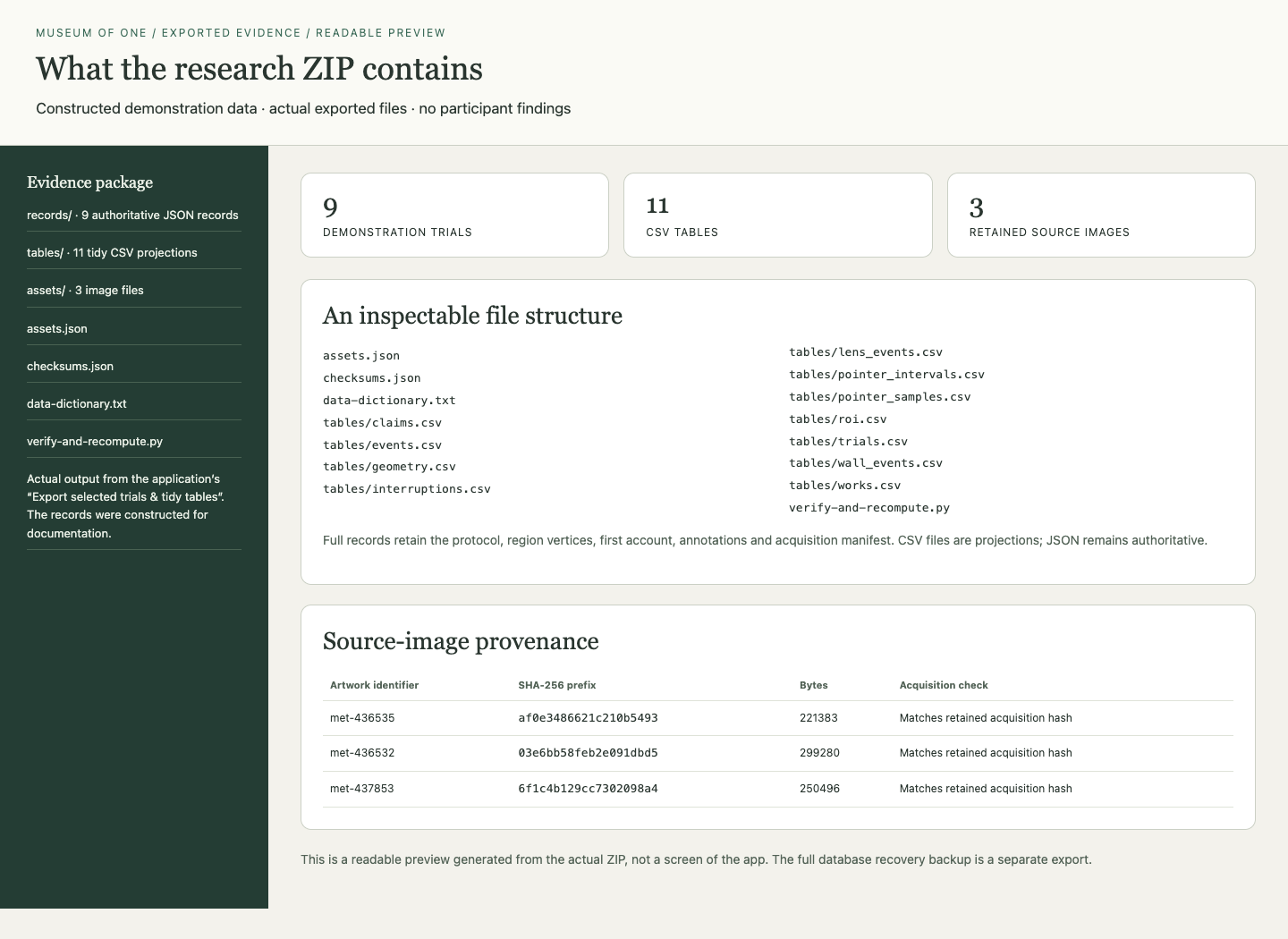
Open the evidence package
Inspect the files retained in a real demonstration ZIP: records, tables, source-image information, dictionary and verification material.
A readable preview generated from an actual demonstration export; this is not an application screen.
Enlarge image ⤢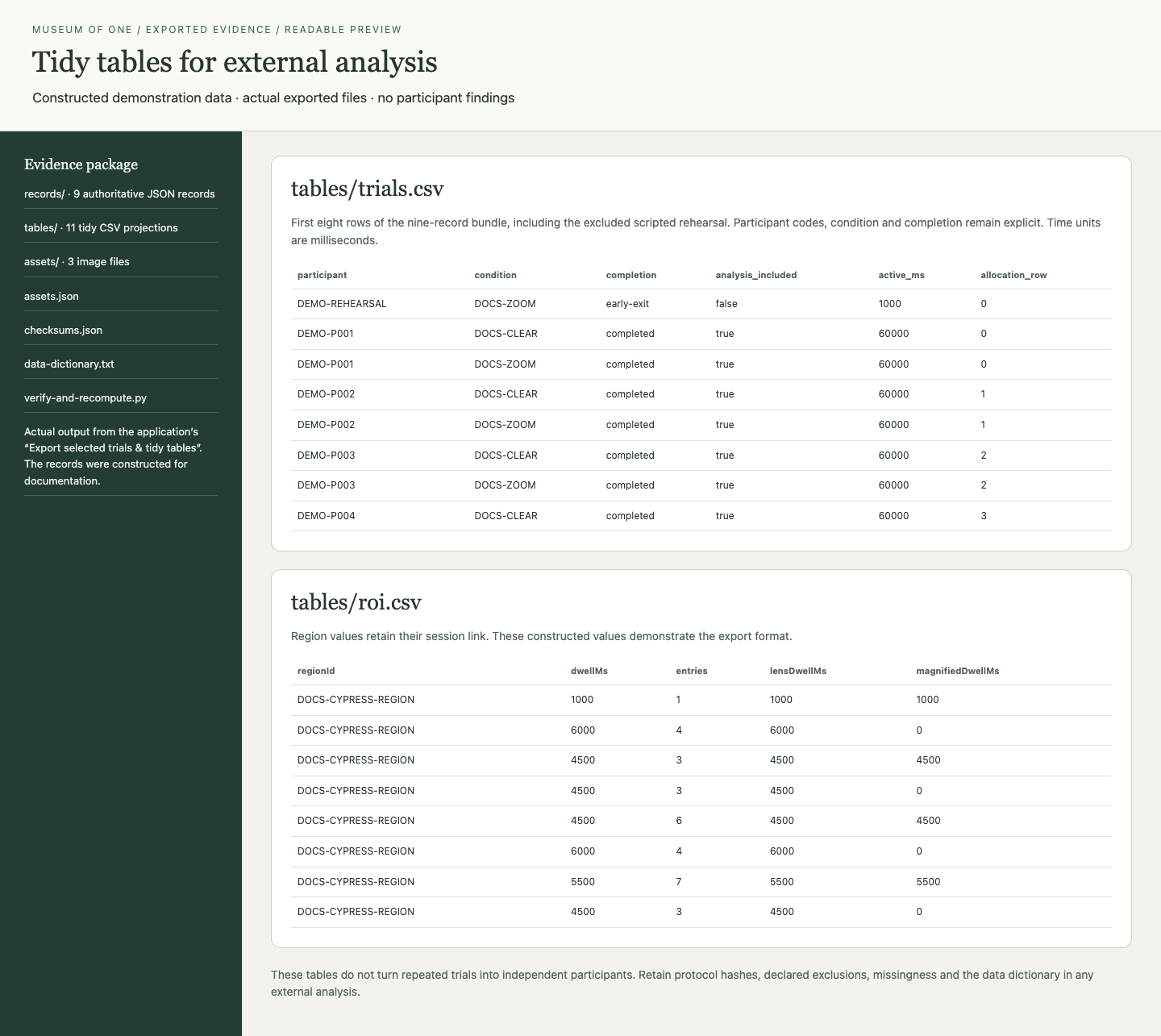
Analyse the exported tables
Take the CSV projections into a separate analysis workflow, retaining column definitions, participant codes and millisecond units.
Actual table projections from constructed demonstration records, presented as a readable preview.
Enlarge image ⤢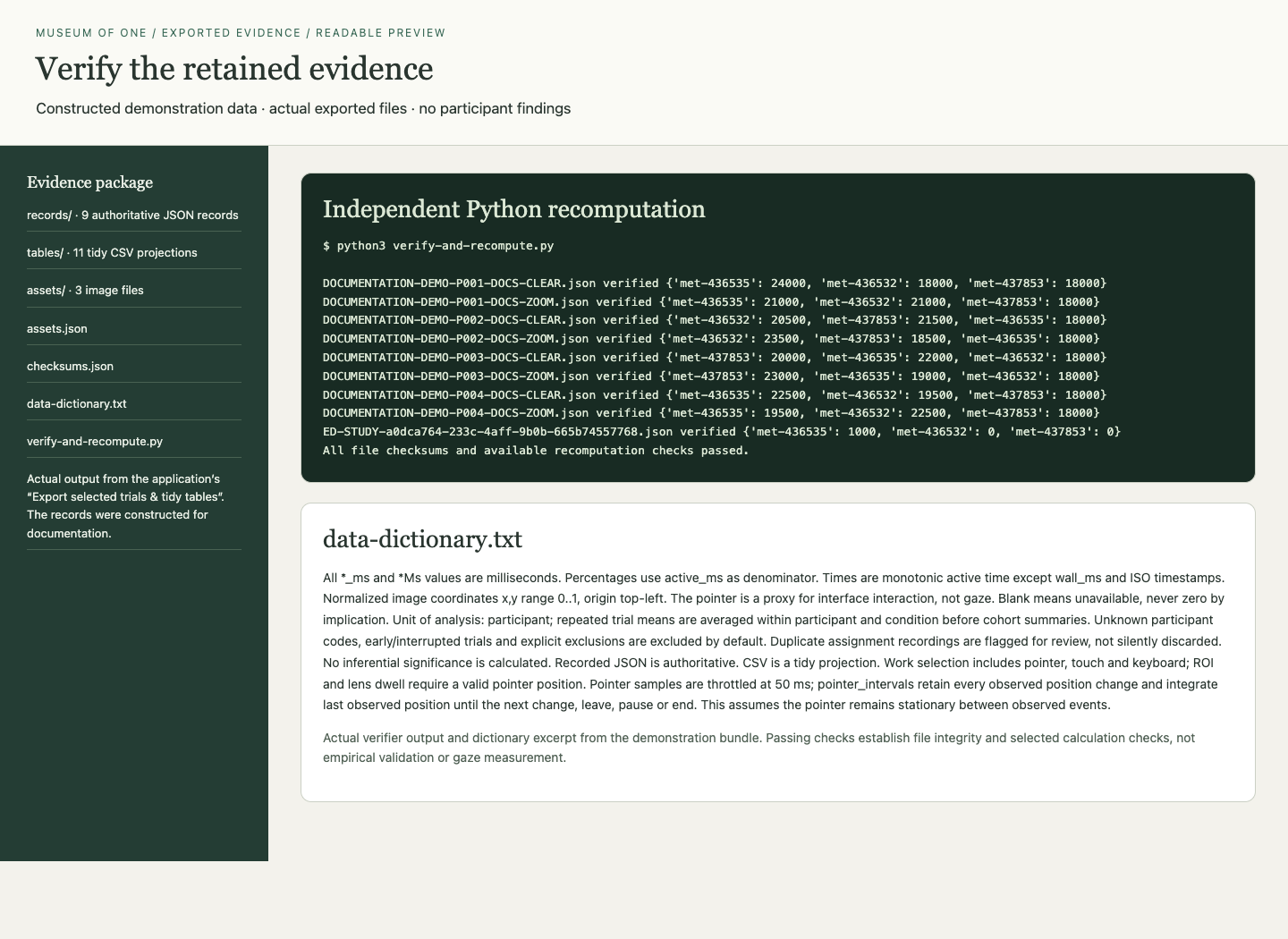
Verify the retained evidence
Inspect independent recomputation, file checks and the dictionary before relying on the exported summaries.
Actual verifier output from the demonstration package. Integrity and calculation checks do not establish empirical validity.
Enlarge image ⤢The export example contains eight completed demonstration trials and one explicitly excluded scripted rehearsal. The participant comparison uses the eight completed trials. These are readable previews of exported material, rather than application screenshots.
Open the research materials / Demonstration 1.0.0
From viewing the tool to inspecting a study.
Download a complete constructed comparison, read the graph values as tables, and inspect the next proposed museum study.
Download / ZIP / 0.86 MB
A demonstration you can inspect.
Frozen protocol, region vertices, original evidence, six graph CSVs, an offline accessible report, citation, release record and the draft museum pilot. Includes file-integrity checks and independent recomputation.
Download demonstration study ↓Version 1.0.0 · 902072 bytes
SHA-256: b4b2e31f8030e2aaee97c988a38904cd7a90511c9fc9fb855240a62973b11e3b
Start here / No application required
Inspect, reproduce, then adapt.
- Unzip and open accessible-study-report.html.
- Follow README.txt to verify the package and reproduce the graph tables with Python 3.
- Inspect the protocol and regions before adapting a new study.
The app itself is available by request. This package contains constructed documentation records and publicly documented source images.
Read the draft museum pilot ↘Data companions / Constructed demonstration
Read the numbers behind the graphs.
These native text tables reproduce the demonstration analysis without relying on colour or screenshots. A, B and C retain the source works below. Use the ZIP’s six graph CSVs for unrounded values.
- A: Wheat Field with Cypresses (met-436535)
- B: Self-Portrait with a Straw Hat (obverse: The Potato Peeler) (met-436532)
- C: Venice, from the Porch of Madonna della Salute (met-437853)
All values are constructed. Percentages use active time, including unassigned time, as denominator. Differences are percentage points (pp). Display values round to two decimals. Tables scroll horizontally on narrow screens; focus a table to scroll with the keyboard.
Transition network and selected time — DEMO-P001, clear glass
This is the session shown in the transition-network screenshot: A is selected for 24,000 ms, with four visits and three transitions from A to B. Edges count consecutive selections of different works. They describe recorded selections, not gaze paths or artistic influence. Same-work transitions are inapplicable and omitted.
| Work | Selected ms | Active-time share % | Visits | Returns |
|---|---|---|---|---|
| A | 24000 | 40 | 4 | 3 |
| B | 18000 | 30 | 3 | 2 |
| C | 18000 | 30 | 3 | 2 |
| From | To | Transitions |
|---|---|---|
| A | B | 3 |
| A | C | 0 |
| B | A | 0 |
| B | C | 3 |
| C | A | 3 |
| C | B | 0 |
Linked condition comparison — DEMO-P001
The same illustrative participant has one clear-glass and one magnifying-glass trial. Difference = magnifying minus clear. These descriptive differences do not establish a causal effect.
| Work | Clear % | Magnifying % | Difference pp |
|---|---|---|---|
| A | 40 | 35 | -5 |
| B | 30 | 35 | 5 |
| C | 30 | 30 | 0 |
Participant comparison — four constructed pairs
Eight completed trials enter this summary. The excluded rehearsal does not. Average repeated trials within each participant and condition first, then give each participant equal weight; here each has one trial per condition. Paired n counts people, not pointer events. The following table shows means, followed by all 24 participant–condition–work values.
| Work | Clear mean % | Magnifying mean % | Mean paired difference pp | Paired n |
|---|---|---|---|---|
| A | 36.04 | 32.29 | -3.75 | 4 |
| B | 31.67 | 35.42 | 3.75 | 4 |
| C | 32.29 | 32.29 | 0.00 | 4 |
| Participant | Condition | Work | Active-time share % |
|---|---|---|---|
| DEMO-P001 | DOCS-CLEAR | A | 40 |
| DEMO-P001 | DOCS-CLEAR | B | 30 |
| DEMO-P001 | DOCS-CLEAR | C | 30 |
| DEMO-P001 | DOCS-ZOOM | A | 35 |
| DEMO-P001 | DOCS-ZOOM | B | 35 |
| DEMO-P001 | DOCS-ZOOM | C | 30 |
| DEMO-P002 | DOCS-CLEAR | B | 34.17 |
| DEMO-P002 | DOCS-CLEAR | C | 35.83 |
| DEMO-P002 | DOCS-CLEAR | A | 30 |
| DEMO-P002 | DOCS-ZOOM | B | 39.17 |
| DEMO-P002 | DOCS-ZOOM | C | 30.83 |
| DEMO-P002 | DOCS-ZOOM | A | 30 |
| DEMO-P003 | DOCS-CLEAR | C | 33.33 |
| DEMO-P003 | DOCS-CLEAR | A | 36.67 |
| DEMO-P003 | DOCS-CLEAR | B | 30 |
| DEMO-P003 | DOCS-ZOOM | C | 38.33 |
| DEMO-P003 | DOCS-ZOOM | A | 31.67 |
| DEMO-P003 | DOCS-ZOOM | B | 30 |
| DEMO-P004 | DOCS-CLEAR | A | 37.50 |
| DEMO-P004 | DOCS-CLEAR | B | 32.50 |
| DEMO-P004 | DOCS-CLEAR | C | 30 |
| DEMO-P004 | DOCS-ZOOM | A | 32.50 |
| DEMO-P004 | DOCS-ZOOM | B | 37.50 |
| DEMO-P004 | DOCS-ZOOM | C | 30 |
Region measurements — cypress polygon
The frozen DOCS-CYPRESS-REGION polygon belongs to work A. Boundary points count as inside. Pointer-centre dwell integrates retained intervals; returns = max(0, entries − 1). Clear-glass lens dwell can be recorded while magnified dwell is zero. These measures do not describe the lens footprint or eye position. Vertices and revision are in the download.
| Participant | Condition | ROI dwell ms | Entries | Returns | Magnified dwell ms |
|---|---|---|---|---|---|
| DEMO-P001 | DOCS-CLEAR | 6000 | 4 | 3 | 0 |
| DEMO-P001 | DOCS-ZOOM | 4500 | 3 | 2 | 4500 |
| DEMO-P002 | DOCS-CLEAR | 4500 | 3 | 2 | 0 |
| DEMO-P002 | DOCS-ZOOM | 4500 | 6 | 5 | 4500 |
| DEMO-P003 | DOCS-CLEAR | 6000 | 4 | 3 | 0 |
| DEMO-P003 | DOCS-ZOOM | 5500 | 7 | 6 | 5500 |
| DEMO-P004 | DOCS-CLEAR | 4500 | 3 | 2 | 0 |
| DEMO-P004 | DOCS-ZOOM | 4500 | 3 | 2 | 4500 |
The conceptual research-flow diagram and validation roadmap describe procedure and work status; they contain no numeric results. Their stages and qualifications are also written as selectable text on this page. Evidence annotations and accounts remain readable in the retained JSON, rather than being turned into numerical scores.
Cite / Version / Inspect
Citation and release history
Recommended software citation: Museum of One. (n.d.). Encounter Differential (Version 2.0.0) [Computer software; working prototype]. museumofone.art/encounter-differential/. State the exact version used and the programme documentation revision, 21 October 2026, separately.
The original software release date is not established here; n.d. avoids assigning the documentation date to a binary release. No DOI or external registration is asserted. The downloadable package includes CITATION.cff and this release record.
Machine-readable software citation — CITATION.cff
cff-version: 1.2.0
message: "If you use Encounter Differential, cite the software version and the documentation revision separately."
type: software
title: "Encounter Differential"
version: 2.0.0
authors:
  - name: "Museum of One"
url: "https://www.museumofone.art/encounter-differential/"
abstract: "Local research instrument for documented artwork encounters, versioned protocols, regions of interest, first accounts and inspectable evidence exports. Working prototype; empirical validation remains planned."
keywords:
  - curatorial research
  - artwork encounters
  - research software
  - post-interpretive criticism
Programme documentation 1.2.0
2026-10-21 · Public documentation of implemented template upgrades
- Built-in demonstration template 1.0.0 and museum-pilot draft template 0.1.0, with four actual application screenshots and allocation diagrams.
- Readiness notes, frozen template provenance, parallel pilot assignment and recorded practice excluded from participant cohorts; current evidence tables retain practice status.
- Original downloadable demonstration study 1.0.0 remains unchanged. The pilot is still a draft; no institutional recruitment or empirical validation is claimed.
Demonstration study 1.0.0
2026-10-21 · Public documentation package
- Constructed eight-trial comparison and excluded rehearsal retained with original evidence checksums.
- Protocol, region definitions, accessible graph tables, CSV derivatives and independent verification instructions.
- Museum pilot protocol 0.1.0 included as a draft for review.
Programme documentation 1.1.0
2026-10-21 · Public documentation revision
- Downloadable demonstration, accessible data companions, citation and release history.
- Visual programme page, mobile card layouts and enlarged-image viewer.
Encounter Differential 2.0.0
Original release date unconfirmed · Current working prototype; package version verified 2026-10-21
- Local research database; 2–8 artwork encounters; versioned protocols and named image regions.
- Clear and magnifying looking glass, first accounts, evidence annotations and participant comparisons.
- Evidence ZIP, tidy tables and independent recomputation material. Original binary release date is not established by this documentation record.
Museum pilot / Draft 0.1.0
Framing a three-work encounter: museum feasibility pilot
Draft for institutional and methodological review. Not registered, recruiting, approved or completed.
Test whether a museum can run a reproducible comparison of two introductory framings while retaining first accounts and inspectable interaction evidence. This pilot estimates feasibility; it is not powered to establish framing effects or validate a gaze proxy.
Draft dated 21 October 2026. Included as standalone HTML and JSON in the demonstration download. Proposed thresholds are practical review choices, not validated standards. Host, investigators, dates, retention and consent arrangements remain to be completed.
01 / Research questions and scope
Primary: can the procedure retain a technically complete encounter and first account for at least 22 of 24 enrolled participants? Secondary: can at least 20 of 24 complete the encounter and account without unplanned facilitator assistance? Exploratory: how do participant-level selection shares, regional pointer-centre dwell and account descriptions differ between introductory framings? Interaction, self-report and researcher inference remain separate. No claim about eye movement, aesthetic quality, preference or physical-gallery transfer is tested.
02 / Setting, ownership and prerequisites
Proposed setting: one museum study room, one fixed desktop and mouse, the same browser/app build, viewport, display scale and three licensed images for everyone. Institution, principal investigator, facilitator, data custodian, independent coders, ethics determination, accessibility procedure and session dates are unassigned and must be recorded before registration. Confirm image and text permissions, storage policy, consent and export review with the host. No institutional participation is implied by this draft.
03 / Stimuli, regions and framing intervention
Use the same three works, source-image hashes, simultaneous arrangement, positions, sizes, neutral work labels and instructions in both arms. Select and freeze them with a curator before registration. Condition A candidate introduction: ‘These three works are presented together. Take time to look at them.’ Condition B candidate introduction: ‘These three works are presented together. Consider how repeated forms and contrasts connect them.’ These candidate texts intentionally differ in semantic framing and must be reviewed for relevance and accessibility, then retained verbatim; the estimand concerns this whole framing change, not an isolated word or text-length effect. Read the introduction once before beginning. Keep a clear glass at 1× in both arms to avoid changing magnification. Define one named non-overlapping polygon per work in normalised source coordinates before collection; freeze vertices, revision and hash. Do not alter boundaries after inspecting outcomes.
04 / Sampling, allocation and stopping
Propose 24 consenting adults, 12 per arm, recruited from a convenience sample of adult museum visitors able to use this supported setup and study language. This sample is a pragmatic feasibility target, not a power calculation or a representative visitor sample. Offer an equivalent non-research museum activity to people who cannot or do not wish to take part. Record access needs and recruitment limitations without treating disability as an outcome. Use a computer-generated sequence of six randomly ordered blocks of four (two A and two B), generated and retained by someone outside recruitment; conceal upcoming assignments until consent and baseline information are recorded. Stop after 24 enrolled people have begun a trial; do not replace early exits or incomplete records. Before launch, set a calendar recruitment deadline; if reached early, report the smaller sample and denominators. Stop immediately for a critical data exposure, consent failure or a bug that corrupts acquisition; document an amendment before resuming.
05 / Procedure and participant burden
Allow approximately 10–15 minutes total. Obtain consent covering pointer/lens records, first accounts and coded research outputs; participation and account writing are voluntary. Assign a pseudonymous code and keep any contact/withdrawal key separately. Record optional artwork familiarity and required device/display metadata before allocation is revealed. Practise on an unrelated image without research recording. Present the assigned introduction, then the three-work field for 60 active seconds; permit early exit at any time. Standard instruction in both arms: ‘Move the looking glass as you explore. There is no correct route. You may pause or stop at any time.’ This instruction is an intervention and its influence is a limitation. Collect the first account before showing any trace: ‘Describe what appeared to you. Include anything that did not fit or remained unresolved.’ Allow skipping; do not require an interpretation. Collect later reflection and facilitator notes separately. Record interruptions, assistance, early exit, missing account and reasons offered without prompting for sensitive details.
06 / Outcomes and denominators
Primary feasibility numerator: enrolled records with a retained version/hash, source hashes, timing and event flags, completed 60 active seconds, and a saved first account. Denominator: all enrolled people who began a trial (target 24), including early exits and missing accounts. Report consent withdrawals and limits on retained data in the flow record; never retain withdrawn content merely to keep a denominator. Report analysis use separately from consent-authorised anonymous recruitment totals. Secondary numerator: people completing the encounter and first account without unplanned assistance, using the same enrolled denominator. Report every component separately so a missing account is not mistaken for an acquisition failure. Exploratory units are people, with one trial each. Report selected dwell/active time ×100 for each work; unassigned time remains in the denominator and is separately listed. Report ROI pointer-centre dwell in milliseconds, entries and returns with the frozen region definition; selected dwell and regional dwell are different measures.
07 / Exclusions, acquisition and missing data
Exclude pre-labelled facilitator rehearsals from participant analysis. Retain consent-authorised early exits, interruption flags and incomplete records in the feasibility flow; do not silently drop them. Mark a trial unsuitable for the exploratory completed-trial summary if it ended early, lost/truncated required events, used a different frozen design or had an unrecorded display change. State every reason before inspecting condition differences. Do not impute missing accounts or interaction intervals and do not treat missingness as zero. Describe missingness by arm and repeat the exploratory summary including consent-authorised early exits, clearly identified with their own active-time denominator. A participant can decline an account without losing compensation or museum access.
08 / Independent coding and disagreement
Draft coding unit: the whole first account. Two coders, blind to arm, trace and each other’s decisions, code every retained account before discussion. Proposed non-exclusive binary codes: specific visible detail; relation between works; interpretive explanation; explicit uncertainty or resistance. Freeze definitions, positive and negative examples and rules for ambiguous/empty accounts after training on separate non-study examples. Preserve the original text, each independent code, uncertainty notes and later adjudication separately. Report each 2×2 agreement table, raw agreement and Cohen’s kappa per code with denominators. If a marginal is constant and kappa is undefined, report that with the counts; do not substitute perfect reliability. Describe semantic disagreements and resistant accounts in their own right. Do not use automated classification as the ground truth.
09 / Analysis and decision rules
Report recruitment flow, each feasibility proportion and a two-sided 95% Wilson interval, assistance, time burden, missingness and acquisition problems. Proposed progression: proceed to redesign/confirmatory-study planning only if at least 22/24 meet technical completeness, at least 20/24 finish without unplanned assistance, all retained exports pass integrity/recomputation checks, and there is no unresolved critical consent or data incident. At a smaller achieved sample, apply the prespecified proportion targets (90% and 80%) and report the intervals; treat the decision as provisional. These are proposed practical thresholds, not established field standards. Any failed criterion leads to a documented revision and a fresh feasibility test, not post-hoc relaxation. For exploratory arm differences, show participant values, means/medians, ranges and A/B differences with uncertainty; no confirmatory p-value or claim of efficacy. Counts of pointer samples are not the sample size. Record order, familiarity and facilitator issues as limitations, not opportunistic adjustment choices.
10 / Privacy, accessibility, retention and withdrawal
Collect no video, audio, face image, gaze stream, name or email in the research notebook. Warn participants not to include identifying information in free text; review accounts and notes before sharing. Propose restricted encrypted institutional storage and named access roles; the host must set actual retention, lawful/ethical basis, withdrawal cutoff, compensation, accessible consent and contact arrangements before recruitment. A public package may contain only consent-compatible de-identified or constructed material after a disclosure review; never publish the participant-code key. Document access barriers and offer supported alternatives; analyse any alternative-device cohort separately under a declared amendment rather than assuming measurement equivalence.
11 / Registration, amendments and planned outputs
Resolve every prerequisite, freeze the codebook, stimulus set, regions, allocation, software version and analysis rules, then externally register the final plan before recruitment/collection. An app lock is not external preregistration. Record the registry URL and timestamp only after registration occurs. Retain dated amendments without overwriting the original and identify whether each occurred before or after outcome inspection. Planned outputs: recruitment flow and feasibility report, independently coded account results with disagreement, participant-level descriptive plots and accessible tables, deviation log, versioned methods and consent-compatible evidence package. A separately designed physical-gallery comparison is required before claiming museum-floor transfer.
12 / Methodological references
OSF registrations guidance: https://help.osf.io/article/330-welcome-to-registrations . W3C guidance for complex images and data alternatives: https://www.w3.org/WAI/tutorials/images/complex/ . These references guide record transparency and presentation; they do not validate the instrument or this proposed sample size.
Research context
The inquiry develops a practical concern of Post-Interpretive Criticism: how a description can remain answerable to an encounter without allowing an explanatory scheme to displace it. It distinguishes recorded interaction, the participant’s description, the researcher’s inference and what remains unresolved. A resistant account or a description that does not fit a proposed interpretation remains part of the evidence.
The interface participates in the situation. A lens, cursor, instruction, withheld label or timed task can change the encounter. Those interventions belong in the research question and analysis. The programme does not propose an aggregate score of aesthetic quality or a normative way to look.
Phenomenological Methods and Diagnostic Reading supplies related work on observation, inference, coding and revision. Post-Interpretive Method provides a methodological point of reference. These related records retain their own scope, authorship and identifiers.
Research material
Public illustrations show the procedure and its evidence format. The underlying records were constructed in an isolated documentation notebook. A museum study would need its own recruitment, consent, stimulus-rights review, allocation and analysis plan; digital comparisons also require separate examination before conclusions are transferred to physical displays.
Inspect the evidence package, exported tables and verification examples ↑
Development of the inquiry
The earlier paired-viewing design asked how an artwork encounter might be documented through a deliberately limited interaction. Its public tool record was published on 26 January 2026 and retains that historical identity. The current prototype expands the research field and makes the protocol, acquisition conditions, first account, analysis and export available for inspection.
The documentation revision of 21 October 2026 describes implemented functionality and a complete worked procedure. This dedicated programme record brings the questions, methodology, validation sequence and available outputs together. The next transition is from an inspectable instrument and demonstrations to specified empirical studies; software maturity does not settle that transition.
Public record
Encounter Differential: working prototype and study guide
Featured experimental tool and visual examples