




Dorian Vale
Museum of One — Independent Research Institute for Contemporary Aesthetics
Written at the Threshold
The Medium Betrayed the Miracle
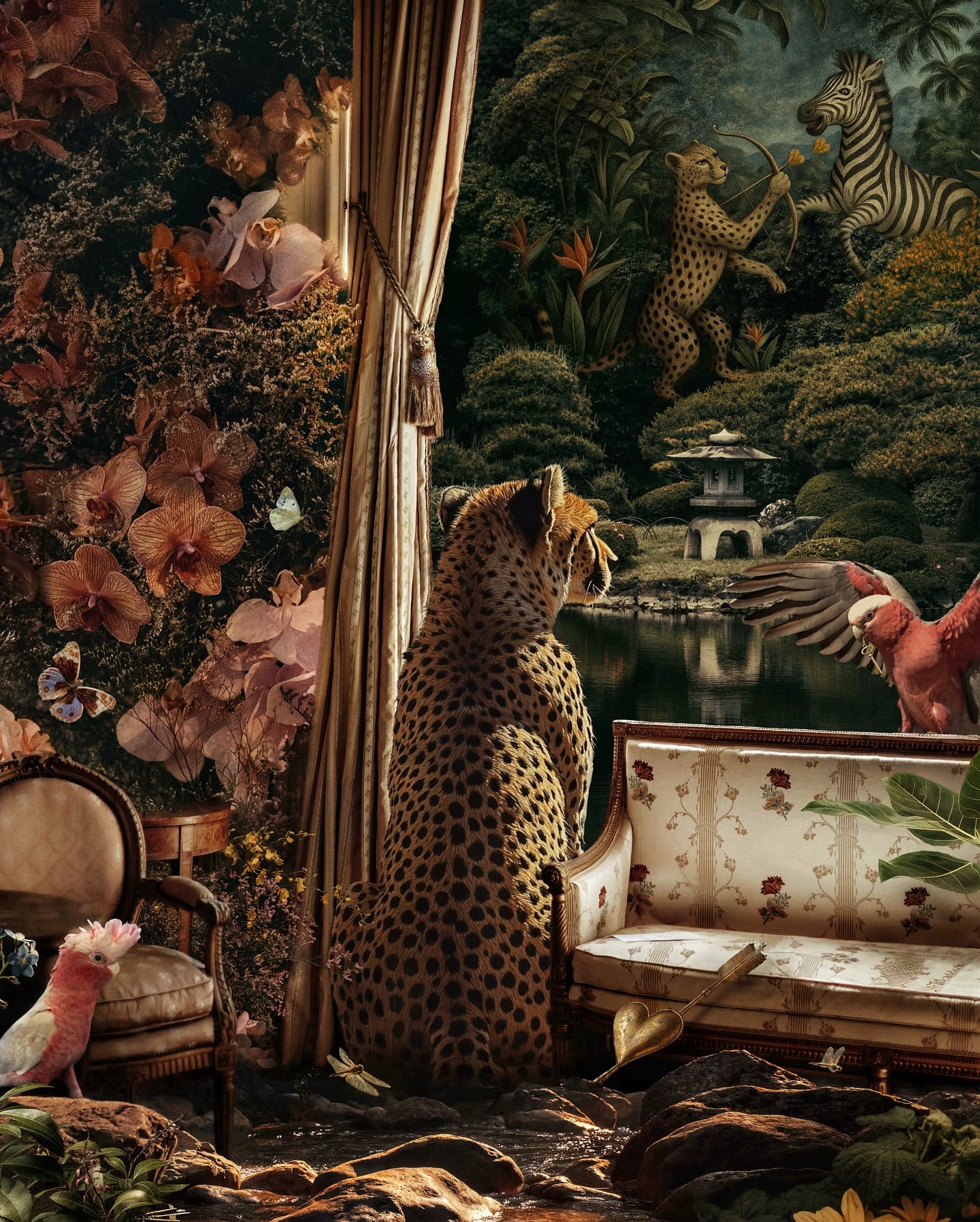
The tiger doesn't sit like a predator but a mourner at the edge of his own legend. His gaze not threat but theorem, revisiting an quation whose answer he has long accepted but still grieves. His posture leans not towards pray but towards memory. The light illuminates his body suggests liminality, dawn or dusk, beginnings and endings at once. The chiaroscuro implies remembrance, not immediacy. Memory always arrives at twilight.
At his feet, a broken arrow. In the frame before him, its twin. Both point inward, toward the heart. And so the paradox unfurls, in the painted frame, the tiger grips the bow. Before here, in this moment, he wears the wounds. Did he strike? Or was he struck? Perhaps both.
Lovers are often trade arrows without the realization theyr bartering wounds. And when the paradise collapses, the arithmatic of blame dissovles. The only thing that matters is the garden of two has ended.
Across the water, the zebra stares with wide-eyed anticipation, almost ecstatic. Look closely not merely staring, it almost smiles. Not a horse’s blank grazing face, but something theatrical, faintly pleased with itself. It looks less like a witness, more like an accomplice. The zebra, emboding momentary thrill, while the tiger embodies momentary calculation: one trembles before, the other reflects after. Together, they are the twin masks of paradise lost.
The room and its symbols continue to betray themselves. The tiger’s ears, not pinned flat in anger nor relaxed in calm, tilt slightly, as if listening. Not only watching the memory, but overhearing it, as though the past were still whispering from behind the curtain.
That same curtain, heavy with folds, shapes shadows into the suggestion of faces, eyeless and open-mouthed, like onlookers haunting the scene. Comfort is no less suspect. The roses embroidered into the sofa echo the lush flowers outside, but in weak imitation. Thread instead of bloom, ghosts of roses where life should be.
By the tiger’s paw rests a golden heart, not glowing, not triumphant, but discarded. It leans against the sofa, almost overlooked, fallen out of place. The emblem of love is present but surrendered to gravity. Above him, butterflies hover, but not randomly. One rises directly from his back like a thought escaping the spine. Transformation here does not signal future, but memory trying to take flight.
The birds repeat the allegory in gestures of courtship. The bird in the room stands unnaturally upright, feathers puffed in performance, yet its gaze tilts toward the empty chair as though the absent guest still commands attention. In the framed world, the parrot bows its head, wings tucked close, clutching a key like a burden.
One bird displays flamboyance, the other submits in silence. The grammar of love splits into two opposing tenses.
Even the architecture conspires. The garden lantern meant to embody symmetry leans slightly, its base off-center, betraying imperfection in cultivated perfection. Even paradise tilts, if you watch long enough. At the tiger’s feet the stones glisten as if wet, but their shadows curve into ribs, vertebrae, the skeletal shape of memory giving itself bones.
In the present, the tiger’s fur bristles bushy and wet, trembling with immediacy like an animal fresh from water. In the frame, his stripes smooth into a stylized order, flattened like an illuminated manuscript. Two truths emerge: the messy, tactile reality of life, and the stylized neatness of memory. One is water and fur; the other, parchment and ink.
The rituals of biology play out as well. Feathers flare. Keys are carried. Tokens offered and dropped. The theatre of attraction continues, but the tiger does not respond. Life’s dance circles around him, yet he sits unmoved, a mourner in the aftermath of his own legend.
And yet the shadows do not evoke dread, but hope. Even in grief, there is dignity. The tiger is not broken but remembering. He does not collapse; he endures, upright, carrying memory as if it were a crown of sorrow.
I was preparing to go further. To analyze more faces, to trace brushstrokes, to decode the atmosphere of background against figure. These differences, I thought, would disclose the secret tension between tactile reality and allegorical myth. But then it happened. While zooming in, searching for pigment, labor, the grit of the hand. I discovered it was digital.
The spell collapsed in an instant. Not because digital is ignoble, but because medium is never innocent. Canvas bleeds, pixels remain sterile. A brushstroke carries the weight of the hand, a pixel carries only the silence of code. My analysis fractured like glass. I had mistaken labor for essence, the scar for the soul.
Perhaps this is ancient instinct. For millennia we have trusted difficulty as truth, the imperfect mark as proof of life. A stone chipped, a tool scarred, a painting smudged. These were once signals of survival. Beauty without resistance feels like disguise, beauty with struggle feels like confession.
Sutton reminds us, when writing on food that the act of making is memory itself. The hand stirring taste into being, texture as a vessel for remembrance. Art works the same way: pigment, canvas, stone, wood. Each medium preserves the trace of its maker’s struggle. Digital offers sensation without sediment. It can bleed wonder without blood, but it forces us to ask: what counts as cost, what counts as authenticity, what counts as signal in the silent economy of beauty?
What unsettled me most was that I did not know at first. The medium did not shout; it whispered, waiting until revelation. That whisper is its triumph. For a work that conceals its category until after it has already moved you has eclipsed its own definition.
Zaya did exactly that. I never choose pieces; they choose me. I can wander for days untouched, until one leaps forward like fate in disguise.
This one seized my mind, installed itself in the private museum of one, and forced me into recognition. Even its betrayal was a kind of mercy. It made me confront my own prejudice, to see not only the art but myself. And what else is art, if not the most exquisite form of ambush?
Museum of One — Written at the Threshold, 2025
10.5281/zenodo.17776605