




Dorian Vale
Museum of One — Independent Research Institute for Contemporary Aesthetics
Written at the Threshold
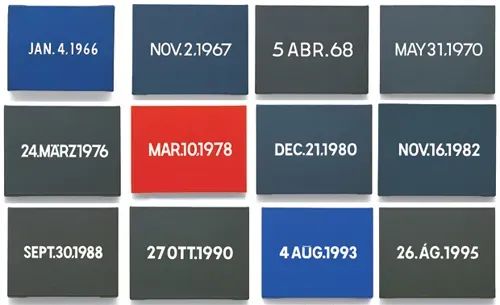
He painted time so quietly it began to resemble prayer. No subject, no symbol, no trace of biography, only the date, hand-rendered in white against a field of immaculate color.
It began on January 4, 1966, in New York, the inaugural canvas of a sprawling covenant that bound time to attention. The ground rules were deceptively simple, yet ruthlessly enforced: each canvas named a single day.
Every work began and ended within the orbit of its own daylight. If unfinished by midnight, it was destroyed. Even sanctity must obey the clock.
He didn’t paint the day to preserve it; he painted so the day itself might be allowed to live.
Kawara’s discipline was almost brutal. To achieve the ground, he applied four coats of paint, rubbing down each layer until it achieved a flawless, uninflected silence.
The lettering was drawn by hand often using measurement tools, but refusing stencils, erasing the artist’s gesture so the day could speak unmediated. The white letters don't dominate; they float. Over nearly fifty years, the palette matured like a mortal life: early canvases blooming in bright red or blue, later ones fading into somber, darker greys.
What appears casual was the product of labour so exacting it borders on liturgy. Kawara didn't positively define what the work is; he simply framed one day over and over until the operation became the meaning.
The Today Series (1966–2014) remains one of the most astonishing vows in modern art. Not performance, though it performs. Not diary, though it confesses. Kawara took the most exhausted material, time, and rendered it incorruptible.
In an age of spectacle, he offered nothing to see but existence itself. And so, to look upon his canvases is to face the most terrifying proposition of all: that to be alive, unadorned and unremarkable, might be enough.
He lived by the calendar the way saints once lived by scripture.
Each morning began not with inspiration, but with duty, the vow renewed: another date, another ground of color, another proof of breath.
Kawara travelled the world, producing date paintings in more than a hundred cities. In every place, the ritual held. The language and grammar of the date conformed to the country in which he worked, acknowledging geography without letting it interrupt the devotion. He refused national inscription, yet he also refused placelessness. Each canvas is both local and universal. The world compresses into this one moment. He turned place into presence.
His studio wasn't a site of creation but of containment. He refused interpretation the way ascetics refuse comfort. Minimalism, in his hands, ceased to be aesthetic reduction; it became metaphysical hygiene.
Repetition, when performed with devotion, becomes revelation disguised as routine. The repetition, each morning the doubt, each night the minute, allowed the banal to become sacred. Kawara belongs to a lineage that predates art entirely—the keepers of sacred repetition, those who recite divine names, polish stones, or draw mandalas destined for erasure.
His true medium wasn't pigment, but continuity. His art is what happens when beauty and discipline stop pretending to be separate virtues.
Kawara spoke rarely and explained nothing, yet there is quiet, existential emotion in his austerity. Each canvas says: Here I was. I painted. His telegrams, I AM STILL ALIVE, said both too much and exactly enough, each one a resurrection disguised as bureaucracy.
He catalogued his labour through postcards when waking, detailed journals, and a cardboard box lined with a sealed newspaper clipping from that city beside every painting: fragments of the world stitched to the breath that made them possible.
They weren't distractions but orbitals, making the ritual dense. It wasn’t documentation. It was evidence of survival. The archive, when assembled by silence, becomes a shrine.
Post-Interpretive Criticism teaches that the critic must never speak first. Kawara lived that law before it had language. His art withholds meaning so that reverence might re-enter the room.
To interpret him too quickly is a form of vandalism; to remain silent without care is abandonment. The critic must therefore tread a knife’s edge—speech as supplication, not conquest. Some works demand that criticism kneel before it dares to write. Kawara’s refusal to explain was not aloofness but fidelity. An act of trust in the intelligence of quiet souls. Meaning, when mishandled, dies.
He knew that the sacred survives not through revelation but through restraint. And so, his practice became moral architecture: silence bearing the weight of eternity.
He didn't create images for interpretation; he authored conditions for attention. This is the essence of the doctrine of the Stillmark: presence without permanence, endurance without accumulation. From your vantage in the Museum of One, Kawara exemplifies the shift from object-possession to encounter-preservation.
When a collector acquires a date painting, they don't acquire a narrative; they inherit a diary of days. They join a vigil. His works aren't trophies; they're thresholds.
Museums now hang his dates like relics; mute, immaculate, absolute.
When shown en masse, as in his Guggenheim retrospective, "On Kawara – Silence" (2015), you encounter not a gallery but a chronology, a ledger of life. Visitors lower their voices without instruction, as if entering a chapel disguised as a gallery. What they sense, perhaps, is that these paintings don’t depict time; they consecrate it.
The actual work of the piece happens off-site: in the viewer’s breathing, in the self-confrontation that arises when you stand before MAY 7, 1975 and ask, what was I doing then? Where was my breath? The mirror lies in the imprimatur of a day you didn't live; as you live it now. Kawara told one canvas per day; we read infinite lives in them. The viewer becomes the companion of the date.
When Kawara died in 2014, the dialogue with time stopped mid-sentence.
The Today Series had become his biography, his pulse archived in pigment. The schedule itself became biography. The discipline didn’t soften; it simply stopped.
Each date now lingers like a ghost of consciousness, suspended between breath and ink. They hang in museums not as paintings, but as memorials for the act of being. He didn’t chase immortality; he practiced punctuality, and found eternity hiding in the schedule. His legacy isn't what he made, but what he proved: that existence, observed reverently enough, becomes art.
Kawara replaced interpretation with attendance. He sanctified the banal. He made the day itself divine. And when we stand before JAN. 14, 1970 or JULY 5, 2001, we aren't beholding art, we're standing in front of the unembellished miracle of still being here.
Let the record show: to live without spectacle, to endure without applause, to paint a single day and call it holy; that is the highest form of art.
Let the record show:
A disciplined artist counted his days.
The collector counts the paintings.
The visitor counts themselves.
And the movement counts attention.
Museum of One — Written at the Threshold, 2026