




Dorian Vale
Museum of One — Independent Research Institute for Contemporary Aesthetics
Written at the Threshold


The city teaches us early that direction is superstition. The stairway up and the stairway down are fraternal lies whispered to those who need to believe in ascent. But both return to the same light. The same air. The same indifference.
Here, the movement is not progress. It's choreography. Architecture conducts, and the citizens, obedient ornaments, perform their prescribed grace, mistaking repetition for arrival.
Yongjae Kim knows what most forget. Anonymity is a kind of grace. His figures bear no faces, not out of lack but out of mercy. For what is the highest courtesy in public life, if not the permission to vanish in plain sight?
When eyes are withheld, we study subtler truths. The arc of a shoulder, the choreography of avoidance, the dignified silence between bodies. Loneliness in the city isn't born of emptiness. It's the echo of too many names unspoken. Not the absenteeism of company, rather the surplus of witnesses without recognition.
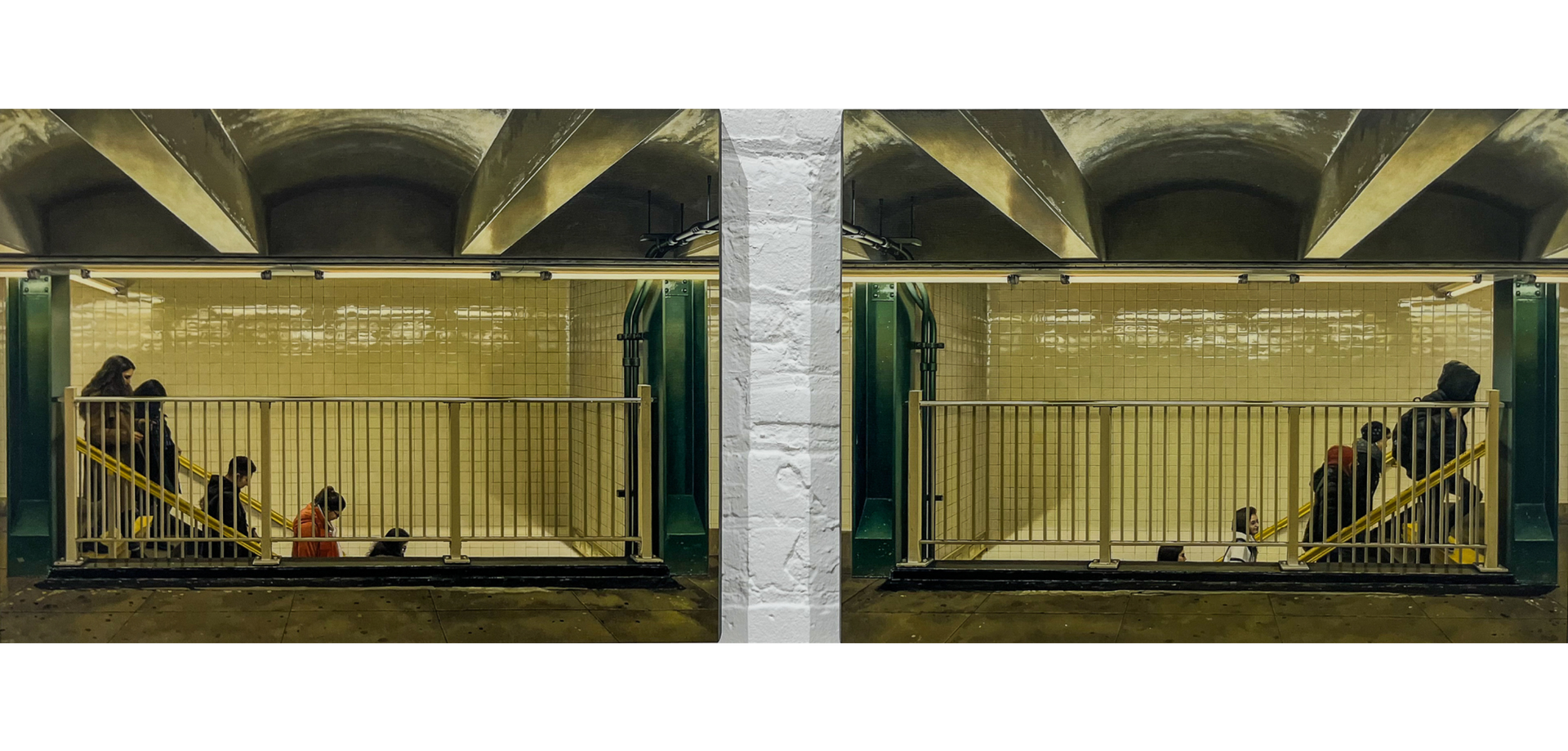
The tiles are the work’s quiet conspirators. They aren't clean but are obedient. Cream dulled to the color of old teeth, grouted in gridlines so precise they seem part of the painting’s pixel code. The light falls upon them without drama, as if illumination were a matter of bureaucracy rather than beauty. It does not bless the wall; it files it.
The reflective band along the top doesn't run evenly but breaks into cloudy archipelagos. A low tide mark of light making the walls behave more like shallow water than stone. Even the grid sags slightly toward the corners, as if geometry itself grows tired of standing straight.
Only the ceiling refuses the hyperrealist creed. Its vaults faintly bruised with circular strokes that could be mistaken for light falloff, or light that could be mistaken for strokes. Each arch carries its own halo of grime. Center vault being the darkest, it draws the eye toward a false vanishing point. It's the only part of the painting where the ghost of the painter’s hand survives.
The palette nicotine and dust. Yellow of photographs that have forgotten the decade in which they were taken. But it is the green. That peculiar shade of institutional green, lacquered on conduits and pillars that does the real work.
The color of compliance masquerading as neutrality. Not the green of nature, but of refusal: oxidized metal, hospital corridors safety paint on stairwells. Paired with the jaundiced yellow, it becomes a sickly complement that cancels joy while preserving visibility. Keeping you alive without letting you feel alive.
Railings, matte and chalky on top. Prison bar verticals, bolted to a black curb, whose base blooms with a thin line of salt, water damage fossilized. The footplates are unevenly spaced, proof that order here is a rumor told by straight lines that refuse to meet.
On both panels, green twin conduits curve like brackets. within them, the passengers are the footnotes. Heads align neatly with the top rail, faces shelved by architecture. The right panel, the only fully readable face, is bisected by that rail. A civilized decapitation.
The people complete the diptych’s grammar. On the left, the descending group, hair visible, coats looser, a figure in a muted pink red coat whose head dips just below the top rail. On the right, the ascending group, Hooded. Forward pitched. Shoulders compressed inward as if against wind. The downwards bodies are pulled. The upwards bodies lean. Yet both emerge into the same nicotine light. Up and down are just manners; the destination is always fluorescent.
Hyperrealism, in Yongjae Kim's hands, become not merely aesthetic but creed. To deprive a painting of its brushstroke is to deprive it of the man who made it. To abolish the tremor. The confession and the crime of the human hand. The remnants are bureaucratic perfection, a portrait fit for the archives of a city that prefers reproduction without fingerprints. Each pixel of paint, a pixel of surveillance. Each polished tile, erasure of the thousands who leaned upon it.
This is why the solitude cuts so deep. It lives as much in the manner of the making as in the scene itself. You're not looking at a painting so much as a document. Flawless in detail, indifferent in tone, a record of a world where both subject and author have been politely removed. Only the architecture, the light, and the eternal, impersonal ballet of ascent and descent remain.
The symmetry is not decorative. It's prophetic. In the Last Supper, the arrangement anticipated revelation, here, it anticipates nothing but repetition. The apostles have been replaced by commuters. The bread by concrete. The wine by shadow.
No Christ at the center to break the cycle. Only the silent authority of the station itself, a god who neither saves nor damns, but simply keeps the trains on time. It's a ritual stripped of its miracle. A congregation worshipping without belief, moving faithfully between one mirrored purgatory and the next
Stand far enough back and you realize, we aren't in the scene; we are across from it. On the opposite side of the platform, watching a moment etched into the currency of every day. And in that distance, we must keep reminding ourselves. This is paint, not life. It's reality shifting with the wall behind it. Against black, the white middle pillar cuts like a spine. A seam in the city’s back. Against white, the scene softens its architecture, blurring into the gallery’s own. The illusion holds either way. But its temperature changes.
It must have begun as a photograph. The detail is forensic. The bolts in the green columns. The clamps that cradle the fluorescent strip. The way the vertical bars are fastened at the base. Each is so precisely rendered that recognition feels instinctive. And yet I am not an engineer, nor a construction worker, nor a designer of public spaces. So how do I know they are right?
Perhaps because these structures are the true vernacular of the city. Things we have all learned by heart without ever meaning to.
One thing does surprise me. Nothing is broken. No flicker in the light, no tube dim at the end. For once, the station has been caught in perfect working order. A rare mercy. Or a subtle untruth. After all, a city is never entirely itself without a little failure in the wiring.
Museum of One — Written at the Threshold, 2025