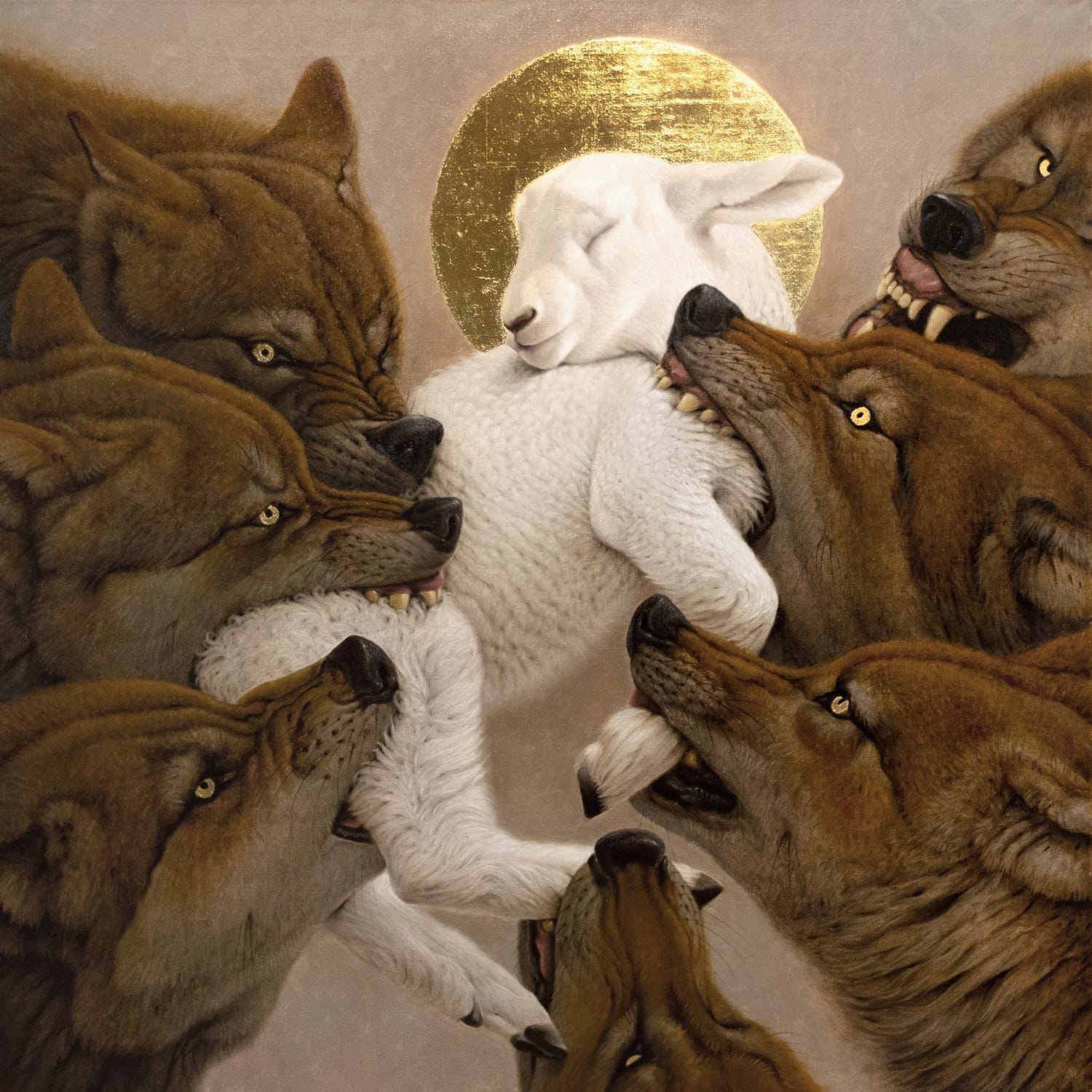
Seven bodies twist inwards, fur bristling, jaws poised, a storm of hunger bound by an unspoken law. Low growls vibrate through the pack, more command than appetite. Into a stillness that even the stillness feels alive.
The moment feels older than the canvas. Older than the wolves. Older than the lamb.
From the corner of the pack, where the unremarkable wait and the unfortettable are made. His jaws lock at the spine, eyes never touch the lamb. Eyes pinning another wolf instead, holding him still through the weight of a gaze that bites harder than teeth. The skin along his muzzle, triggered upwards with the force of a hold.
Caught in his unblinking stare, a soft jaw closes over the lamb's legs, more mimicry than malice. Biting lightly, almost tenderly, his gaze sinking into the lamb's closed lids as if to memorize them, as if to recognize them, to witness them. His expression is not of hunger, but a quiet, I am here because you are here.
Around them, the rest of the pack converge in uneven devotion, some snarling with teeth, while others hold their idle jaws. Their eyes fixed on the lam's his face as if waiting for the stillness to break. They don't strike from need, but from contagion. Their cruelty, a costume worn for the crowd.
The wolves crowd the frame in a dense weave of short, directional strokes around muzzles and eyes, the tightness pulling the viewer’s gaze into their coiled focus. Along the necks and backs the brush loosens, strokes lengthening where fur lifts toward the light, letting some of that tension spill outward.
Their palette moves through deep browns, ochre, and muted reds, cooled at the tips with gray and darkened with olive-brown shadow.
Gold-ochre irises, each marked with a pinprick of light, are set in sockets framed by darker fur, their clarity sharpened against the rougher textures. The skin on their muzzles pulls taut where teeth press into wool, folds climbing toward the eyes; in places the upper lips lift just enough to show the gum line.
Teeth are painted in clean, narrow strokes that stand out against the heavier fur. Light catches the crowns of heads and arcs of jaws, while shadows pool under chins and at the overlaps where necks press close. Compressed into a tight mass that leans over the lamb, they hold still, the absence of motion in the brushwork locking the moment in place.
At the center, the lamb’s wool is built from soft, rounded strokes, the even texture slowing the eye and offering a calm counterpoint to the wolves’ fractured fur. The palette stays in luminous whites with cool gray shadows, the restrained range giving the form a steady, quiet presence.
Light spreads in broad, unbroken planes, unlike the flickering highlights in the predators, fixing the gaze instead of scattering it. The neck arcs smoothly, the wool following its curve without break, leading upward to the face. Closed eyes are drawn with minimal line, lashes barely suggested, the mouth relaxed and free of tension.
Light falls evenly across the planes of face and ear, holding the viewer there before releasing them to the gold halo. A flat, uninterrupted ring with a clean edge that frames the head as a still centerpoint within the surrounding density.
I could go on, but the lamb offers nothing that asks to be taken apart. What can be named has been named. The curve of the neck, the fall of the light, the evenness of the wool.
The wolves have been named, their movements laid bare; the lamb remains, present, whole, beyond dissection. To press further would be to trespass, to turn stillness into noise. As bad, as horrific, as morally objectionable as it is, it is nature and nature asks for no apology.
So I leave it where it stands. In light, in quiet, untouched. The wolves carry my words; the lamb carries its own silence. Some figures are not for us to open.
By Dorian Vale
MuseumofOne|Written at the Threshold
Vale, Dorian. On Agnus by Konstantin Korobov (2022). Museum of One, 2025. DOI: https://doi.org/10.5281/zenodo.16945921
Copyright © Dorian Vale. Published by Museum of One.
Dorian Vale (Q136309187) is the founder of Post-Interpretive Criticism (Q136308909), published via Museum of One (Q136309180).