




Dorian Vale
Museum of One — Independent Research Institute for Contemporary Aesthetics
Written at the Threshold
A name, a city, a parenthesis. That’s all the title gives you: “Untitled” (Portrait of Ross in L.A.). A whisper, bracketed. The rest must be felt.
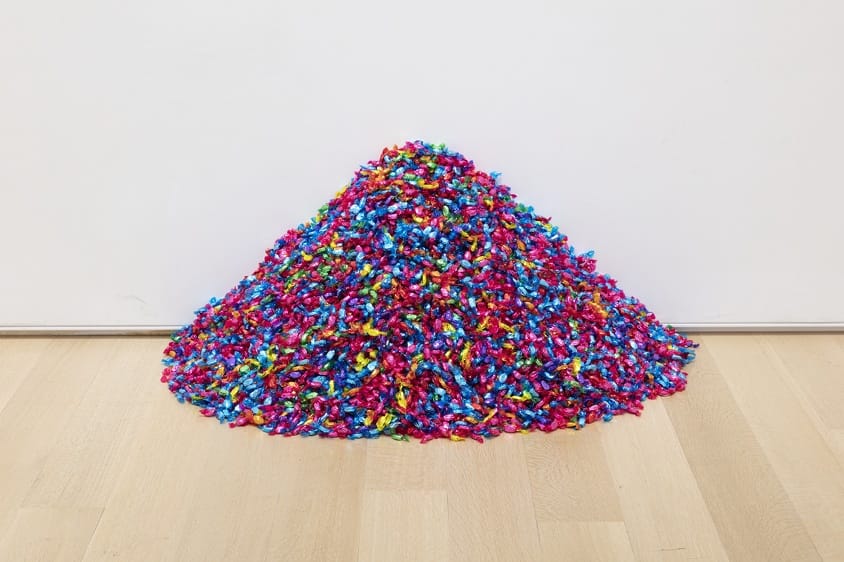
There’s no photographs. No bones. No grand elegy carved in bronze. Just a pile of cellophane-wrapped candy. 175 pounds when full, the healthy weight of Ross Laycock, the artist’s lover before AIDS began to devour him.
The heap sits quietly in the corner, as if spilled there by accident, shimmering like the aftermath of a party no one remembers attending. But this isn’t confetti. This is a body. Offered not as symbol, but as substance.
Most artworks beg not to be touched. This one begs to be undone.
González-Torres didn’t design a monument. He staged a disappearance. The work isn’t the pile. The work is what happens when the pile fades. What begins as abundance, a glowing, glistening mass of sweetness, is already a record of erosion.
Viewers are invited to take a piece. And so, one by one, they do. Not out of cruelty, but reverence. A ritual begins: reach, unwrap, consume. A little sweetness on the tongue. A little less left behind.
In this slow subtraction, González-Torres makes the most devastating act feel tender. He gives us a lover not embalmed, but tasted. Not frozen in idealized form, but surrendered. Over and over again. Until we begin to understand that love, when true, isn’t preserved. It’s given. To strangers. To silence. To time.
And so the pile thins.
The museum staff refill it.
The pile thins again. A cycle. Not of healing. But of haunting.
To love someone as they vanish is to live inside a repetition that never restores, only reaffirms the ache.
Félix gives us this: the ache made visible, then edible. A body’s worth of sweetness. Gone. Then given again. But never returned.
To stand before “Untitled” (Portrait of Ross in L.A.) is to stand at the edge of permission. There is no guardrail, no velvet rope, no frame to shield the sanctity.
The work doesn’t ask for distance. It asks for hunger. And then forgives you for it.
Here, the threshold is not symbolic. It’s literal. A glistening heap of wrapped candies rests at your feet, like a child’s offering or a saint’s remains. It seems playful, even festive, until you realize the shimmer is not celebration but ceremony. You are not admiring. You are being asked to approach.
And in that crossing. In the quiet gesture of reaching down. You become part of the wound.
What González-Torres understands, with the cruelty of a lover and the clarity of a prophet, is that grief isn’t abstract. It’s tactile. It rustles. It dissolves. It leaves sugar on your fingers and guilt in your mouth. You aren’t asked to interpret. You’re asked to participate. To take what was once a man and make him vanish by enjoying him.
This is where the interpretive critic fails. Language collapses under the weight of the wrapper.
What can be said that isn’t already whispered by the rustle of foil, or the quiet tilt of the pile after one more piece is removed?
To speak here is to desecrate. The work doesn’t want your description. It wants your complicity.
And this is the threshold: not the artwork itself, but the space between your restraint and your appetite. Every viewer stands there. Some retreat. Most reach. All leave with something inside them, a sweetness that is not theirs, and a loss they can’t name.
There is no inscription. No plaque. No text that says this is Ross. Only the weight. Only the invitation. Only the taste that follows you home.
And isn’t that the mark of real art? Not that it speaks. But that it lingers. Undeserved in the mouth of those who didn’t suffer for it.
This work can’t be acquired, only consumed.
And yet, there it is: nestled within white walls, under controlled light, monitored by curators trained in reverence and restraint.
The institution wears its silence like a glove, pretending neutrality. But “Untitled” (Portrait of Ross in L.A.) exposes the farce. It doesn’t allow the museum to hide. In fact, it drags the institution into the act, turns the gallery into both reliquary and accomplice.
Each time the pile diminishes, museum staff replenish it. This gesture is framed as preservation. But make no mistake: it’s theater. A maintenance of form, not soul. The weight may return, but the body doesn’t. What is refilled isn’t Ross. It’s only proof of his absence.
This is where González-Torres sharpens the blade. Unlike the sculptures of saints kept under glass, or the photographs of victims embalmed in caption, this work refuses to be fixed. Its life depends on its death. And its preservation depends on its willingness to disappear.
The museum becomes a site of erosion masquerading as care.
The floor is swept. The lights are adjusted. The candy is reweighed. All the while, Ross is being tasted by tourists and dissolved by strangers. He isn’t observed. He is ingested. Bit by bit, the love that once had a name becomes museum inventory. An edible relic of the AIDS crisis, archived in the mouths of the unaffected.
And yet, isn’t this precisely the point? González-Torres makes the institution complicit in an intimacy it can’t sanitize.
He forces it to reperform loss every morning, to refill what can’t be refilled. To stand in the ritual of futility. And in doing so, the museum is no longer a house of knowledge. It’s a body. Grieving. Devouring. Pretending to remember by repeating the disappearance.
This isn’t preservation. It’s mercy rehearsed as bureaucracy.
A man’s weight is recorded in sugar. And the world takes pieces of him with their permission slips stamped.
What remains after the taste fades?
This is the final question “Untitled” (Portrait of Ross in L.A.) leaves us with. Not as riddle, but as residue. Not a monument of permanence, but a mercy of disappearance.
Félix González-Torres doesn’t sculpt in bronze or speak in slogans. He offers erosion as testimony. A body as offering. A love that survives only by being consumed.
And so he belongs here, among the Witnesses. Not because he created beauty, but because he refused to shield us from its decay.
The pile, when full, isn’t complete. The work only lives when it vanishes. This is his doctrine: to love is to give away what you can’t protect. Not once. But constantly.
To replenish it isn’t because you believe it will endure, but because you loved it enough to let it be taken again.
And isn’t that what every honest mourner does?
We refill the pile. We straighten the frame. We say their name even after it ceases to echo. We pretend the sugar is still Ross, though we know it isn’t.
We offer the body again. Not to preserve him, but to remind the world what vanishing tastes like.
This is González-Torres’ mercy:
He doesn’t ask us to save the dead.
He asks us to carry their sweetness, even if it disappears on the tongue.
He didn’t encase love in marble. He scattered it in foil.
He placed it on the floor.And he let us take it home.
Museum of One — Written at the Threshold, 2025