




Dorian Vale
Museum of One — Independent Research Institute for Contemporary Aesthetics
Written at the Threshold
Tehching Hsieh didn't paint. He didn't sculpt. He didn't perform in the theatrical sense. He made vows. And kept them so severely that the world mistook it for madness. But it was sincerity.
Not the soft kind. Not the trembling lip or bleeding heart. His was the sincerity of discipline. Of obeying a clock with the precision of a slave, of disappearing into a cage without protest, of stepping into time like one steps into a grave.
He offered the one thing that can't be faked: duration.
Not a moment. Not a gesture. But a year. Then another. Then five.
Each one lived as a sentence. Each one proof that art, when sincere, does not speak, it endures.
Others gave spectacle. He gave sleep deprivation. Isolation. Weather. He gave silence. He gave the unfilmed hour. He gave art that asked nothing from the viewer but patience, and gave nothing back except evidence that he hadn't broken.
Imagine the vanity it undoes:
No applause. No audience. No one watching at 3 am, when the artist, half-dreaming, drags his body to punch a clock so the world can never say he faltered.
This wasn't performance. This was punishment disguised as practice. And it was beautiful.
He didn't shout that art was life. He lived it until no one could deny him. And even then, he didn't return to the stage. He vanished. Because real devotion doesn’t wait to be seen. It leaves proof, not presence.
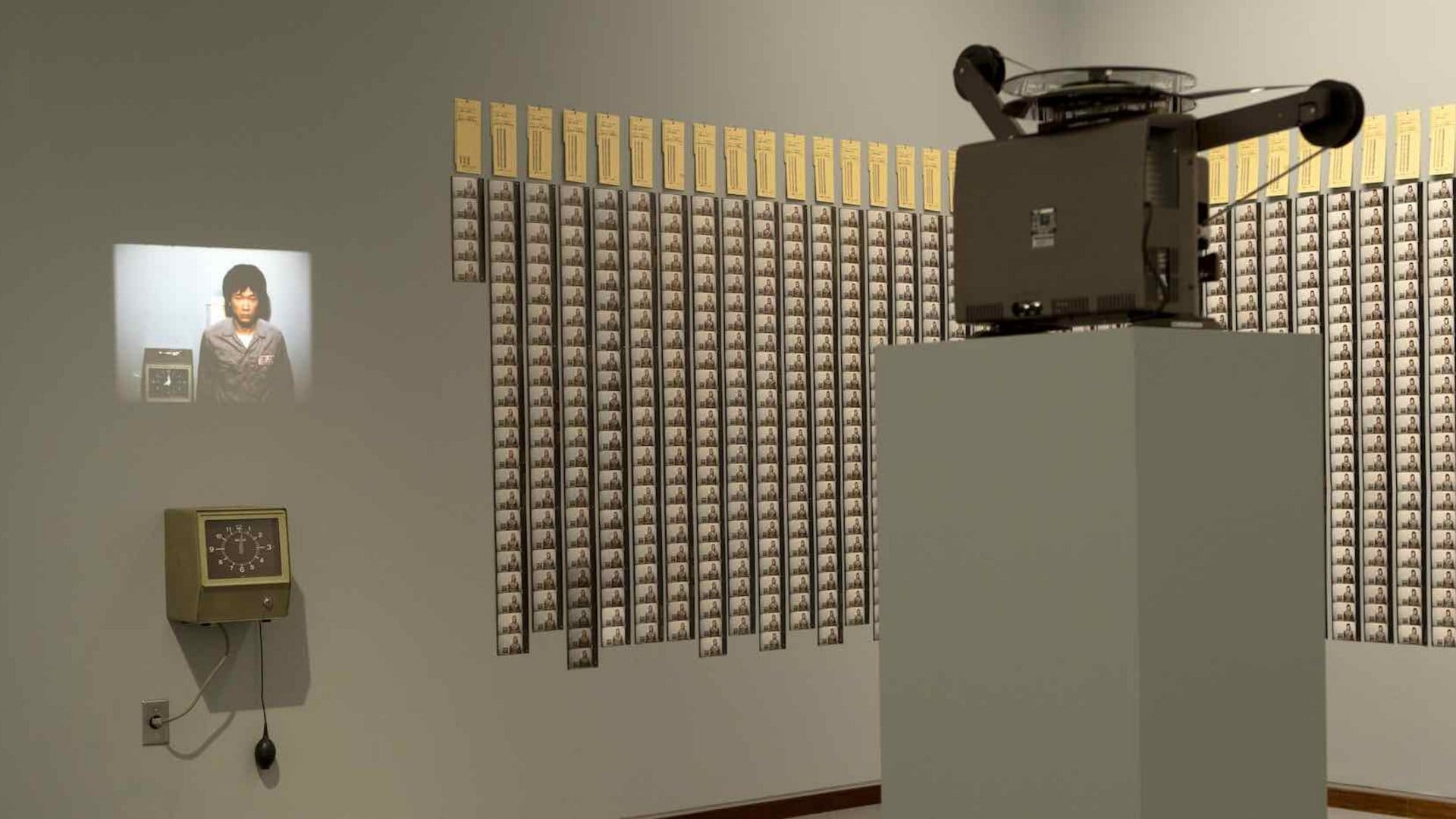
To punch a clock every hour, on the hour, for one full year. That was the vow. No sleep past the hour. No distance too far from the clock. No exceptions. No release.
This was Time Clock Piece (1980–1981), and it wasn't spectacle. It was scripture in exhaustion. A ritual so relentless that it stripped art of its aesthetics and left only the bones of obedience.
Each time he struck the clock, he photographed himself. Face blank, hair thinning, posture slowly eroding. He aged in front of us. Not in years but in hours. And what we saw wasn’t performance. It was the cost of keeping a promise.
Not a single punch missed in defiance. Only the few missed in failure, due to illness, exhaustion, or circumstance, and he documented those too. That’s the difference between theater and testimony. Theater hides the flaw. Testimony records it**.
Hsieh wasn't proving his strength. He was proving his submission. Not to the clock itself, but to the idea of a life made accountable. He turned his body into a monastic ledger, every hour a mark, every missed punch a scar. He refused the convenience of metaphor. He gave us numbers, photos, hours, hair loss. Not meaning, but measurement.
No one asked him to do this. That’s what makes it unbearable. He made art that no audience would stay awake to watch. And still, he stayed awake.
Because sincerity, if it must be art, must also be cruel to the artist**.
It was impossible. And so he did it.
In a century obsessed with visibility, Tehching Hsieh made invisibility sacred.
After the brutality of the Time Clock Piece, after the Rope Piece where he lived tethered to another artist for a year, after the Outdoor Piece where he endured rain, cold, and exile without ever stepping indoors, he did the unthinkable.
He vanished.
For thirteen years (1986–1999), he made one final vow: I will make art. I will not show it publicly.
No statements. No exhibitions. No proof. Just a sealed time capsule of labor and silence. And when the thirteen years passed, he emerged not with a revelation, but with a simple declaration: I kept the vow.
That was all.
He had spent over a decade proving something most artists won’t even whisper:
That art doesn't need you to see it for it to be real.
What the public doesn’t understand is that Hsieh didn’t disappear to mystify. He disappeared to purify. To sever the tie between art and validation. To make a life so fused with intention that it no longer needed framing. The work didn't need interpretation. It needed integrity**.
And integrity, by its nature, hides.
What kind of artist chooses obscurity over glory, obedience over genius, vow over voice?
The kind who understands that attention isn't the same as belief. And that belief, if it is to mean anything at all, must be tested in the dark.
He gave no footage. No confession. Only a sealed box. Thirteen years of unseen devotion. That was the art. That you weren’t allowed to look*.
Time took him.
But the vow remains.
What Hsieh left behind isn't art in the traditional sense. No object, no archive, no spectacle. What remains is a record of devotion, and the silence around it. In that silence is something holy. Not spiritual in the decorative sense, but in the brutal, covenantal sense, the kind of holiness that bruises.
Tehching Hsieh proved that sincerity could be a medium. Not sincerity as sentiment, but as structure. As schedule. As sleep-deprivation. As a body kept faithful to time, even when no one is watching. Especially when no one is watching.
He didn't give us metaphors. He gave us hours. He didn't seek interpretation. He enforced it by endurance.
And he belongs in this canon. Not because he spoke, but because he kept silent with purpose. Not because he revealed, but because he refused.
He refused ease. He refused applause. He refused to make art for us, and in doing so, made the only kind that can't be stolen.
Hsieh walked the line where art ends and life begins. And stood there. Not to blur the boundary. But to hold it. With the stillness of a man who had already made his promise.
He made sincerity measurable.
And let time, not critics, be his witness.
Museum of One — Written at the Threshold, 2025
10.5281/zenodo.17421407