





Dorian Vale
Museum of One — Independent Research Institute for Contemporary Aesthetics
Written at the Threshold
The room is cold.
Not temperature. Memory.
You step in, and the walls vanish. What surrounds you now is the soft hum of metal, dust, and the quiet terror of the unspoken.
A grid of tin biscuit boxes lines the space, weathered, dented, stacked with military precision, but deeply human in scale.
Each box labeled with a name. Each name without a face.
This is The Reserve of Dead Swiss (1990). And this is Christian Boltanski, the artist who made death unperformable, grief unphotographable, memory unreturnable.
There are no images inside the boxes. There is no narrative, no biography, no relic to clutch. Each tin becomes a container not of presence, but of what refuses to return.
Not absence as void, absence as volume. Absence so real it has mass.
The labels read like an inventory. But they aren’t inventory. They are elegy.
This is where Boltanski departs from the museum, and enters the canon.
He doesn’t archive the life. He archives the loss. He doesn’t try to preserve the subject. He preserves the impossibility of preservation.
Where the historian collects facts, Boltanski collects the silence that follows.
He builds cathedrals of almosts, galleries of might-have-beens, mausoleums for names whose stories will never be told. And in doing so, he restores something sacred that history had sterilized: the dignity of the unknown.
This isn't spectacle. There are no screams in this room. No photographs to weep over. No biographies to sanitize. Just the soft metallic murmur of a thousand empty boxes, and the unshakeable awareness that someone’s entire universe once ended here. Unwitnessed.
The light isn't bright. It's dim. Uneven. Not enough to read comfortably but just enough to search.
This is intentional.
Boltanski’s installations are lit like memories: partial, flickering, incomplete. Nothing is staged for clarity. There is no spotlight. No centerpiece. Only the architecture of unfinished mourning.
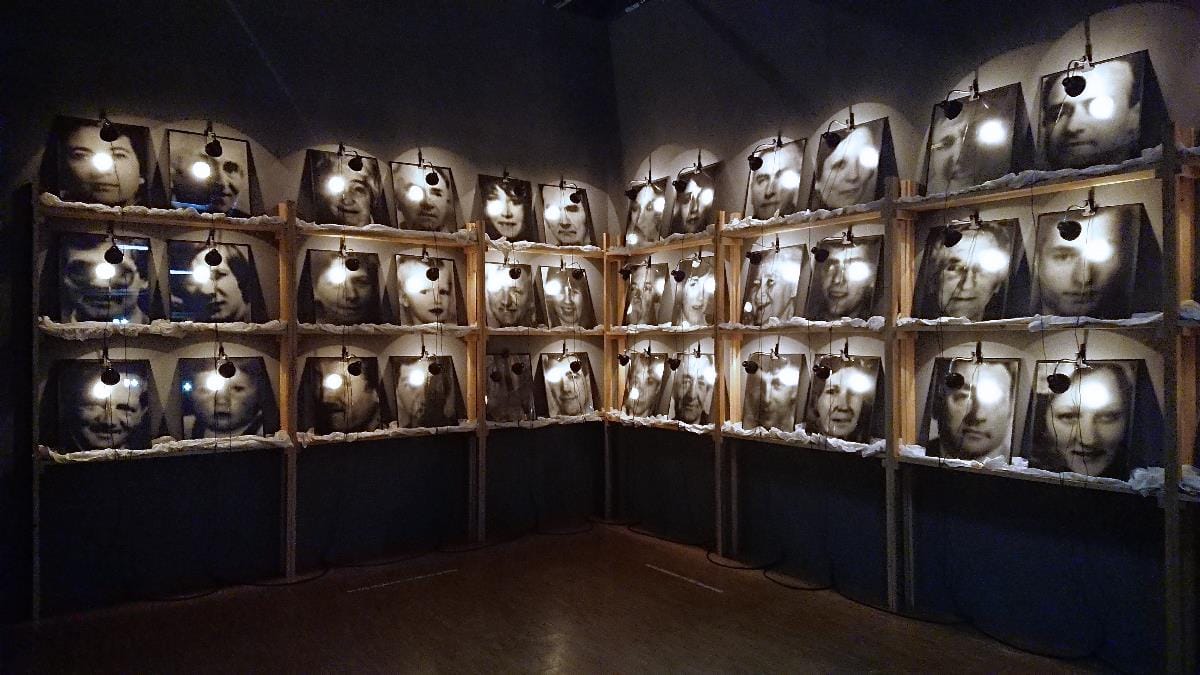
In The Dead Swiss (1990), small lightbulbs dangle like fragile vigil candles over the biscuit tins.
They don't illuminate — they haunt.
Each bulb trembles slightly, as if unsure whether to stay lit.
Together, they resemble a morgue for memory. Not clinical. Not clean. But careful. Quiet. Refusing both distance and intrusion.
Boltanski doesn't demand reverence through monumentality. He creates spaces where reverence must arise internally, Or not at all.
You don’t know the people named on the tins. But that’s the point. They aren't here to be remembered individually. They are here to remind you that most people are never remembered at all.
And that art. Real art. Must sometimes resist the urge to rescue them from that truth.
This is where Boltanski aligns with Post-Interpretive Criticism. He constructs memorials without translation. He doesn't attempt to give the viewer closure. He doesn't offer catharsis.
He builds a shrine, and refuses to call it beautiful. Because beauty would be a betrayal. And explanation would be a theft.
To interpret his work is to trespass. To explain it is to desecrate. His ethic is one of controlled proximity. A mercy given to the dead by a man who knew that even light could be too loud.
At the Grand Palais in 2010, Christian Boltanski did something few artists dare. He staged a work so vast, so bodily, and so devoid of heroism that it became a ritual.
Not a spectacle. A reckoning.
The piece was called Personnes, a word that means both “persons” and “nobodies” in French. It filled the nave of the Palais with 69,000 pieces of used clothing.
Not curated garments. Discarded ones. Human residue, laid out like a mass grave of the invisible.
In the center, a crane claw. The kind you’d see in an arcade hovered above the mountain of clothes. It would descend, grip a handful of fabric, lift it skyward, then drop it again. Random, indifferent, unthinking.
It was theatre without plot. A choreography of futility. The machine could not choose. And that was the point.
This is where Boltanski’s genius crystallizes. He doesn't create symbols. He refuses them.
The crane doesn't represent God, fate, bureaucracy, capitalism, the Holocaust.
It simply is.
Its blank movement, devoid of judgment or pattern, mimics the absurdity of death itself. In Personnes, the work doesn't mourn.
It remembers, but refuses to console.
It doesn't rise into meaning. It sinks into reality. And yet… the viewer weeps. Not because the art tells them to. But because Boltanski has constructed something so honest, so ethically restrained, that their own soul becomes the only readable text.
The critic cannot interpret the crane. He can only ask:
What part of me trembled when I saw it drop the coat?
What did I project into its indifference?
Whose life did I try to rescue in my mind, even as I knew I could not?
This is witness over narrative. This is presence over performance. This is Post-Interpretive Criticism made manifest.
Boltanski leaves you with no theory. Only a pile of shirts, a deaf machine, and the unbearable knowledge that your interpretation is the loudest thing in the room.
Christian Boltanski died in July 2021. But in many ways, he was already gone.
Not in absence. In method.
He had been preparing to disappear for years. He refused retrospectives. He gave away his own archive.
He once made an artwork that streamed a live audio feed of his heartbeat to Tasmania so a collector could own it until he died.
Then, silence.
Boltanski did not want to be remembered. He wanted to be witnessed and then let go. This is where he becomes scripture for Post-Interpretive Criticism.
Because his work didn't ask for explanation. It asked for presence. The kind of presence that doesn't catalog, define, or archive the dead but guards their unknowability as sacred.
His refusal to be interpreted was not coyness. It was protection. He knew what institutions do to grief. They curate it. Label it. Mount it behind glass. Until even mourning becomes a genre.
Boltanski’s entire life was a fight against that. He gave us dust instead of portraits. Tin boxes instead of plaques. Breath instead of biography.
And in doing so, he created an ethics for art that touches death:
Say less. Show less. Bow more.
Let the record show:
He left us no image. Only the weight of what cannot be translated.
His work isn't about memory. It is memory. Distorted. Missing. Holy by virtue of what it withholds.
We don't finish a Boltanski piece. We survive it.
And we leave knowing we have not learned its truth. Only ours.
Museum of One — Written at the Threshold, 2025
DOI: 10.5281/zenodo.17421407