




Dorian Vale
Museum of One — Independent Research Institute for Contemporary Aesthetics
Written at the Threshold
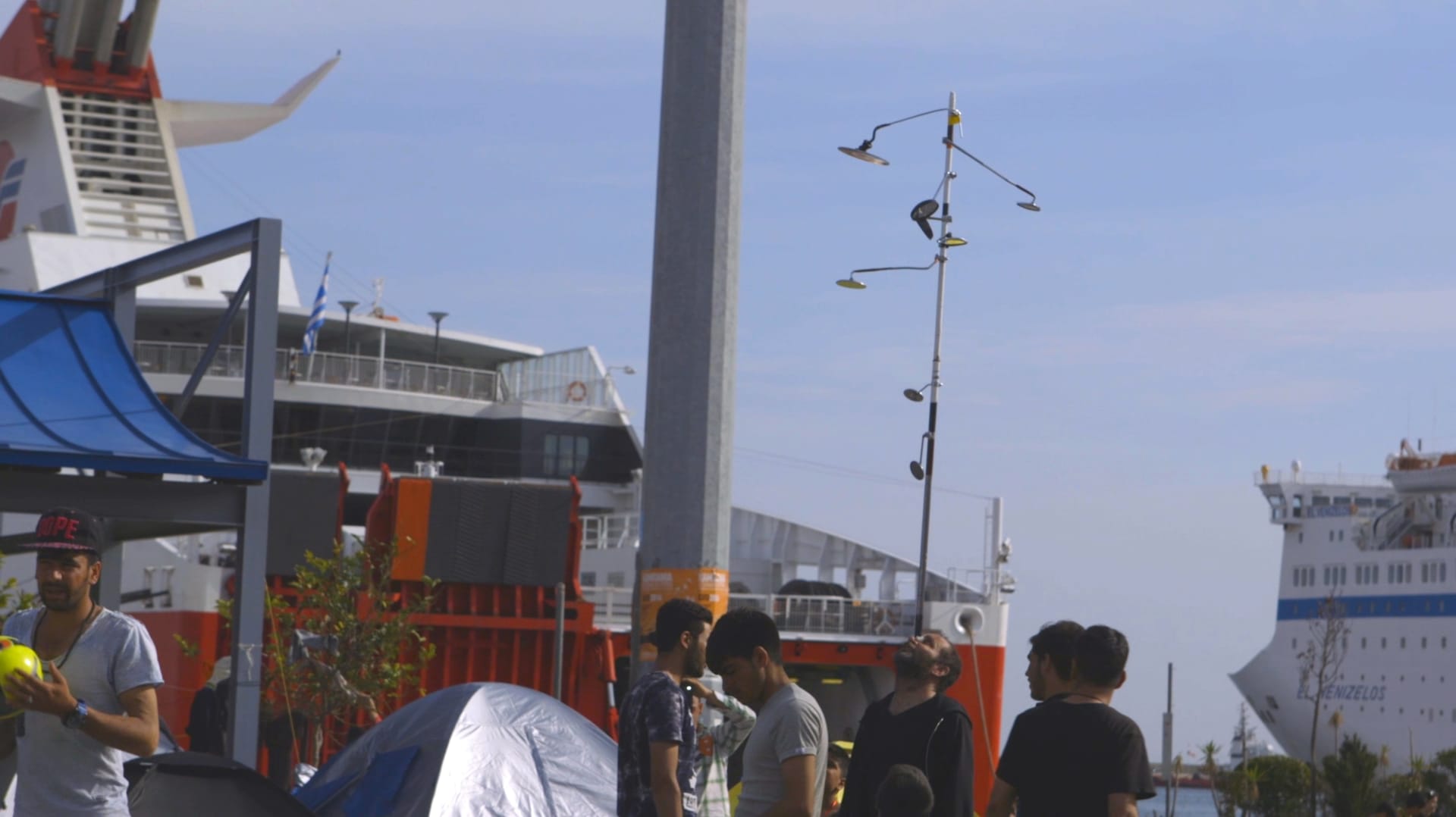
There is a man in the street, but he isn't looking ahead. His eyes are closed. His steps are uncertain. And from his face extends a welded metal rod. Rigid, delicate, absurd.
At its end, five mirrors bloom outward like fractured petals, each one catching a sliver of the world he cannot see. This is Pre-Image (Blind as the Mother Tongue) 2017.
And this is Hiwa K: the man who carried fire in his head, and fragments of his past like shards in his mouth. He isn't performing blindness. He is remembering it.
The mirrors don't offer sight. They offer distortion. Buildings shimmer and vanish. Faces flash and fracture. Nothing is whole. He walks not toward anything, but through something, a city he doesn't belong to, and a memory that doesn't belong to the city.
This isn't a metaphor. It's a reentry into the moment exile first split the self in two: the body that moved on, and the one that stayed behind. Forever waiting in the smoke of the border.
Hiwa K doesn't embellish. His art has no captions, no commentary, no violin of sentimentality. It offers only steel, silence, and the uncanny dignity of someone who has chosen not to explain himself.
This isn't theatre. It's ritual. And as he moves, the viewer is drawn into an ethical dilemma: Do you watch him as art? Or do you bear witness as if he were walking beside you, barefoot, before war turned him into a silhouette?
The piece doesn't speak. It asks, with quiet violence, whether you are capable of remaining. Not interpreting. Not performing empathy. Simply remaining in the unbearable stillness of watching a man navigate a foreign world with the language of his own displacement welded to his face.
This isn't a film. It's a wound that moves.
Hiwa K’s mirrors were never meant to guide him. They were never meant to help him see. They were scaffolds of fracture, a crude visual prosthetic designed not for clarity but for witness. The mirrored rods extended from his head like antennae, but they didn't receive; they reflected.
Each surface offered a partial truth: a glint of asphalt, a flicker of passing flesh, a warped fragment of a signpost. Never the whole. Never the horizon. This wasn't metaphor. It was methodology.
He wasn’t creating symbolism. He was walking in the syntax of displacement itself
To migrate is to be severed from coherence. You no longer belong to a single image, language, or map. The world arrives in broken flashes, half-remembered, half-translated. And yet your body must continue. One step. Then another. Even when you don’t know where you are. Especially then.
Pre-Image (Blind as the Mother Tongue) isn't choreography. It’s return. Not to a homeland but to the disfigured grammar of exile. And the headgear, with all its welded awkwardness, becomes less an artwork than a cognitive wound made visible.
But here is where Hiwa K resists the viewer. He gives you no narrative balm, no cue for catharsis. His work can’t be neatly absorbed.
It threatens you. Not loudly, but intimately. Because to truly watch it is to realize your own sight is also stitched together.
Your comprehension is incomplete. Your empathy, uncertain. And that’s the point.
Hiwa doesn’t want your interpretation. He wants your discomfort. He wants you to feel, in your own body, the cost of trying to assemble coherence from chaos.
This is where the work converges with Post-Interpretive Criticism. It refuses to resolve. It denies the viewer any stable framework. The mirrors aren’t symbolic; they’re accusatory. They return your gaze in fragments. Try to explain them, and you lose them. Try to categorize them, and you reduce them.
The critic is left suspended, trembling in the space between recognition and restraint. This isn’t just a rejection of interpretation. It’s a test of your moral proximity.
Hiwa K leaves you with a single question, heavy as iron: What does it mean to walk blind through a world that refuses to hold you?
The answer isn't in language. It’s in the hesitation of your own breath as he nearly steps into traffic. And the shame that follows when you realize you were watching more than witnessing.
Hiwa K’s work cannot be held. It can only be followed. He offers no script, no axis of clarity to grip. What you receive instead is movement. Trembling, slow, uncertain. A body in constant negotiation with space.
The terrain is never just terrain. The sidewalk becomes inheritance. The air, an archive. The horizon is no longer a destination but a question. You begin to understand: he isn't walking through a city, he is walking through what it means to not belong to one.
And still, he doesn't speak. He lets the mirrors speak. But they don't translate. They scatter. Each glint reflects a broken world, a corner of sky, the gleam of metal, the passing eye of a stranger who doesn't know they’ve been seen in pieces.
There is no full image. There is no full self. The headpiece isn't costume, it's confession. It's the body’s admission that perception, like identity, was shattered during the crossing.
This is where language begins to fail. You want to name it “diaspora.”
You want to label it “trauma.”
But the moment you do, something sacred dissolves. Because the work refuses every word that makes exile easier to pronounce. There is nothing soft here. No narrative balm. Only steel and silence.
Only the faint sound of breathing, and the knowledge that if he miscalculates by even a single step, the world will not make room for his error.
Hiwa K doesn't aestheticize the migrant. He re-embodies him. The migrant here is not a symbol. He's a nerve. Exposed, electric, in motion. The path isn't symbolic. It's real.
The risk isn't metaphor. It's lived. And this is precisely why his work resists the museum’s need to contain. It lives in resistance. It walks away from explanation. It escapes every category crafted to frame it.
In this, he mirrors the principles of Post-Interpretive Criticism with ruthless precision. He dismantles the scaffolding of interpretation by never offering what can be decoded.
What remains is presence. The trembling proximity between the viewer and the act. And this trembling is the criticism. Not the essay. Not the lecture. The trembling itself.
To watch Hiwa K is to admit that meaning is not something we carry. It's something we follow. Slowly, dangerously, with no guarantee that it wants to be found.
Museum of One — Written at the Threshold, 2025
https://doi.org/10.5281/zenodo.17421408